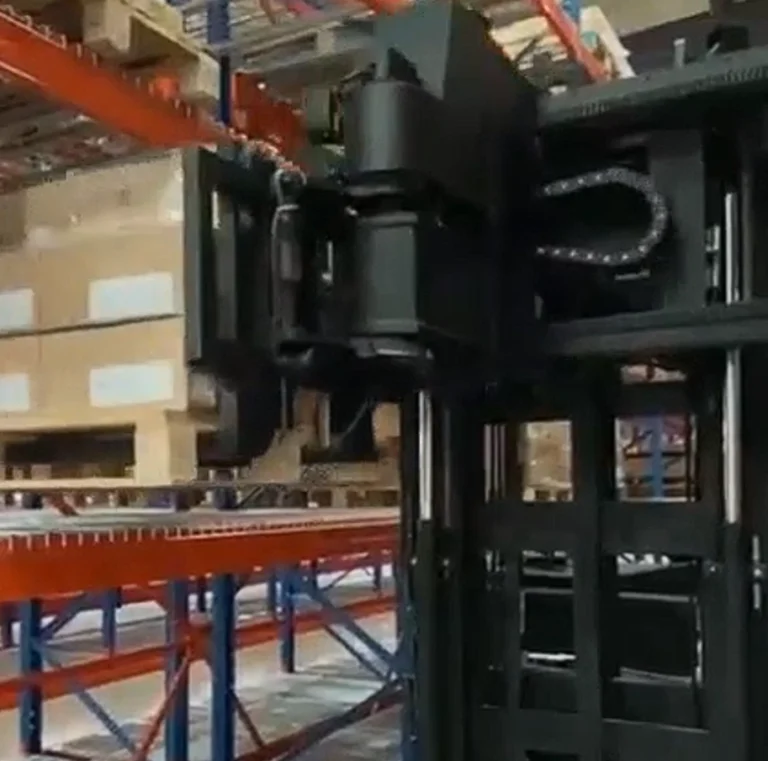
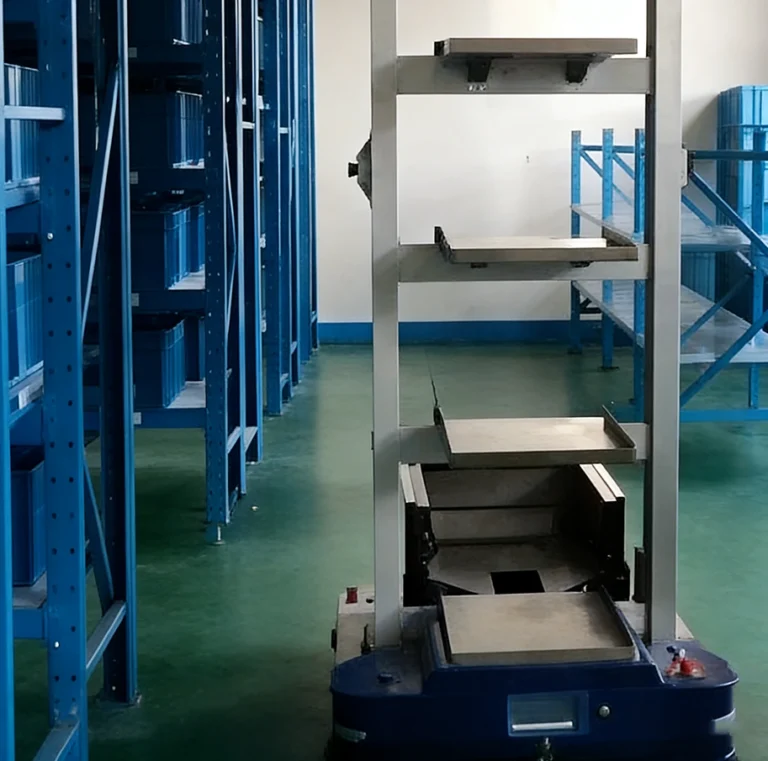
Project Background
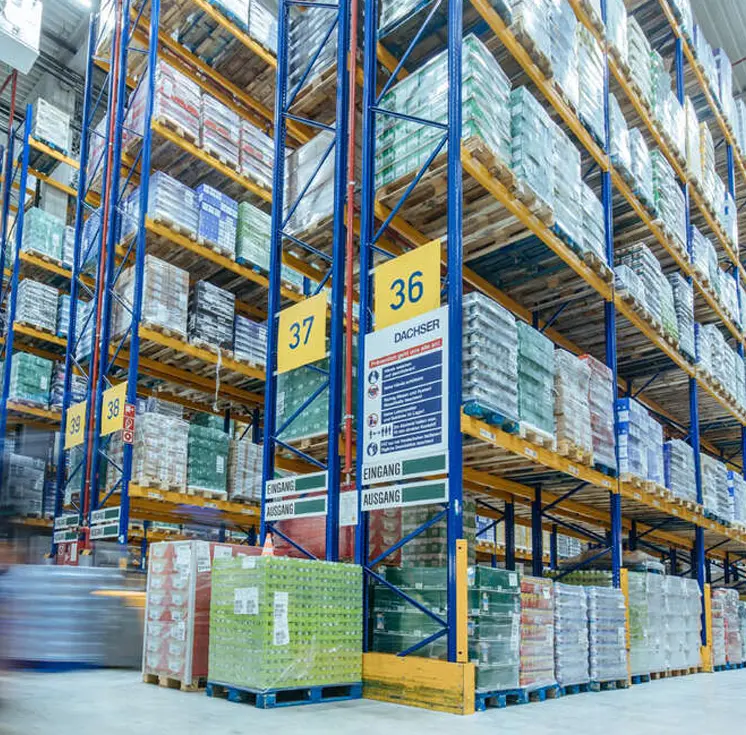
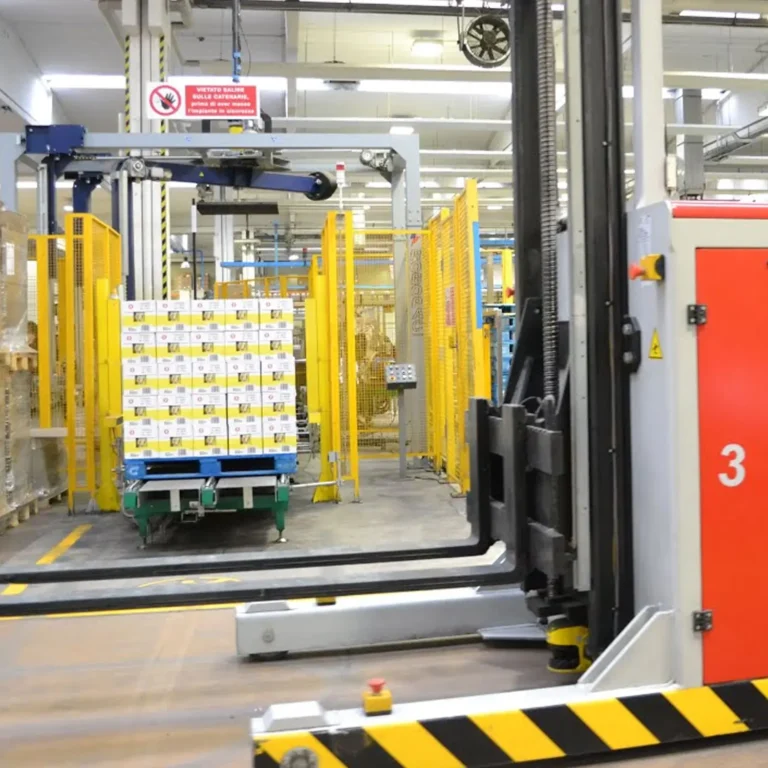
A large packaging manufacturer in China operates a 150,000 square meter facility. While its production lines had already achieved a high level of automation, material handling within the plant still depended on manual labor. To improve overall production efficiency, the company decided to implement an intelligent intralogistics system for its workshop operations.
Project Objectives
On Site Assessment and Data Analysis
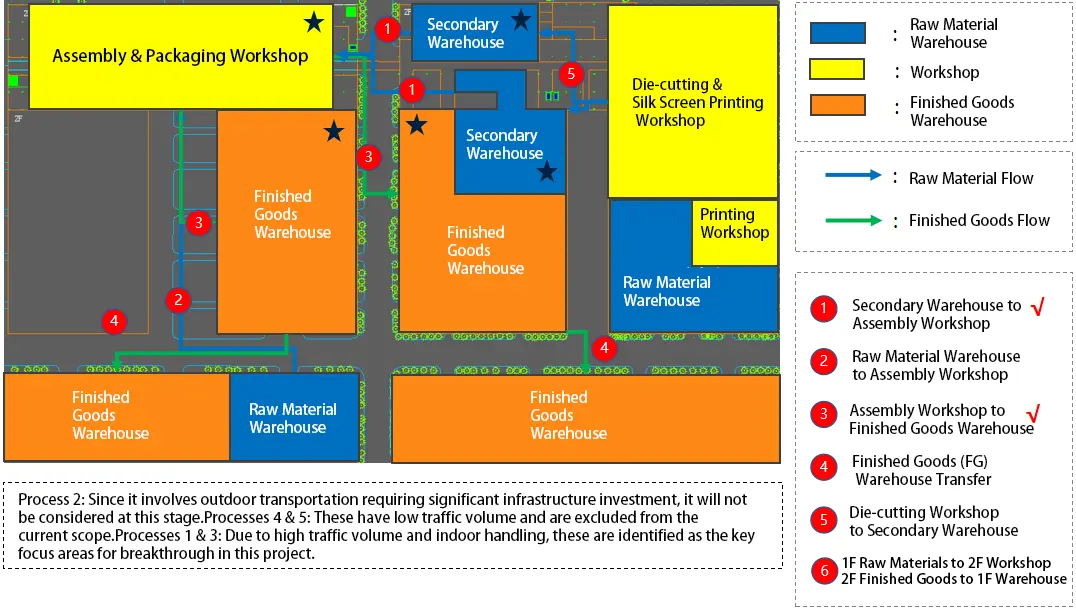
Facility Layout
Number of floors/buildings: 8 buildings in total. The assembly workshop has a two story layout, while all other areas are single story.
Project scope: The first floor workshop, the secondary warehouse, and the finished goods warehouse.
Current Layout and Workflow on the First Floor of the Building
Material Flow Volume Analysis
For the main areas covered by this project, the daily material handling volume was analyzed based on data provided by the logistics department on December 11. Details are shown below.
| Product Name | Output (Pcs) | Delivery Trips | Total Trips | ||||
| Foam | Blister Tray | Carton | Finished Goods | Secondary Warehouse | |||
| Promotional Liquor Box | 10368 | 4 | 3 | 5 | 36 | 15 | 63 |
| Hai Zhi Lan 42° | 13350 | 3 | 2 | 5 | 47 | 11 | 68 |
| Hai Zhi Lan 42° | 13350 | 3 | 2 | 5 | 47 | 11 | 68 |
| Junfang 46° | 12000 | 3 | 1 | 2 | 32 | 7 | 45 |
| Total | 38 | 162 | 44 | 244 | |||
Conclusion:
There are currently four production lines on the first floor.
The total daytime shift flow from the secondary warehouse to the first floor workshop is 44 pallets per day. Based on a half day supply cycle, each line requires 11 storage locations.
The total daytime shift flow from the raw material warehouse is 38 pallets per day. Based on a half day supply cycle, each line requires 10 storage locations.
The total daytime shift flow to the finished goods warehouse is 162 pallets per day. Based on a half day supply cycle, each line requires 40 storage locations.
Summary:
Under a daytime shift only operating model, each production line requires 61 storage locations, including 40 finished goods locations, 10 raw material locations, and 11 semi finished goods locations, with a ratio of 4:1:1.
On Site Assessment and Data Analysis
Solution Approach
AGV Route Description
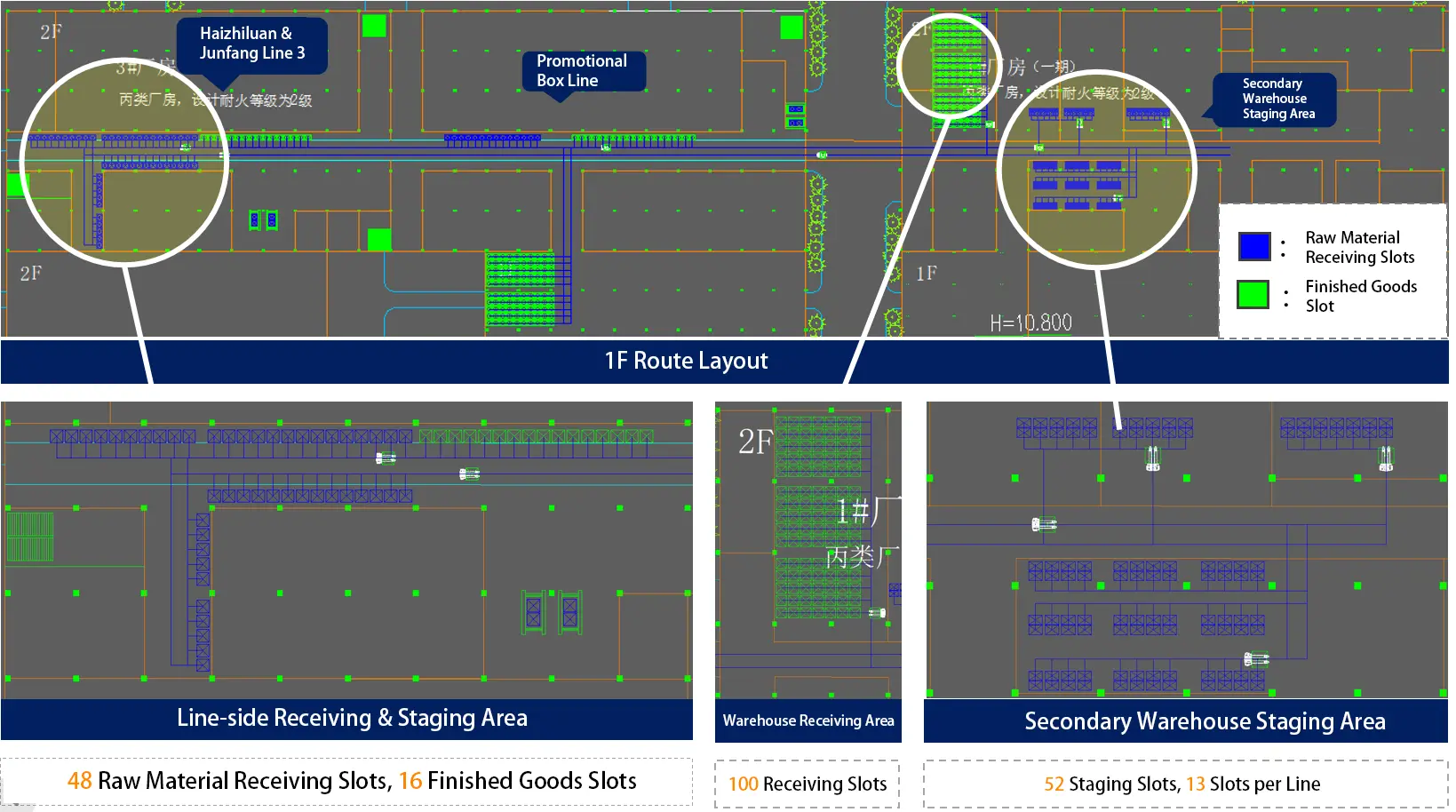
Secondary Warehouse Area:
Preparing all night shift materials during the day shift requires 44 storage locations. We designed 52 locations to allow for distribution across different warehouse zones and to support night shift operations.
Warehouse Receiving Area:
The four production lines require 162 storage locations at night. To allow for different distribution ratios across warehouses, the receiving area is designed with 200 locations.
Workshop Perimeter:
In addition to materials from the secondary warehouse, this area also includes packaging materials, foam, and other items. Each line needs about 10 locations for these materials during the night shift. We also reserved 5 locations per line for secondary warehouse materials to support quick replenishment.
Because finished goods can be transferred to warehouse storage quickly after production, the workshop perimeter currently includes fewer than 20 locations for temporary transfer and inspection waiting.
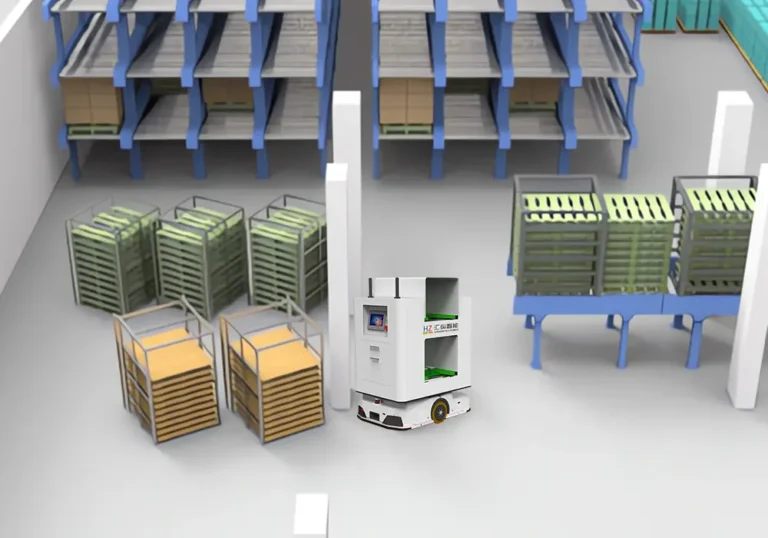
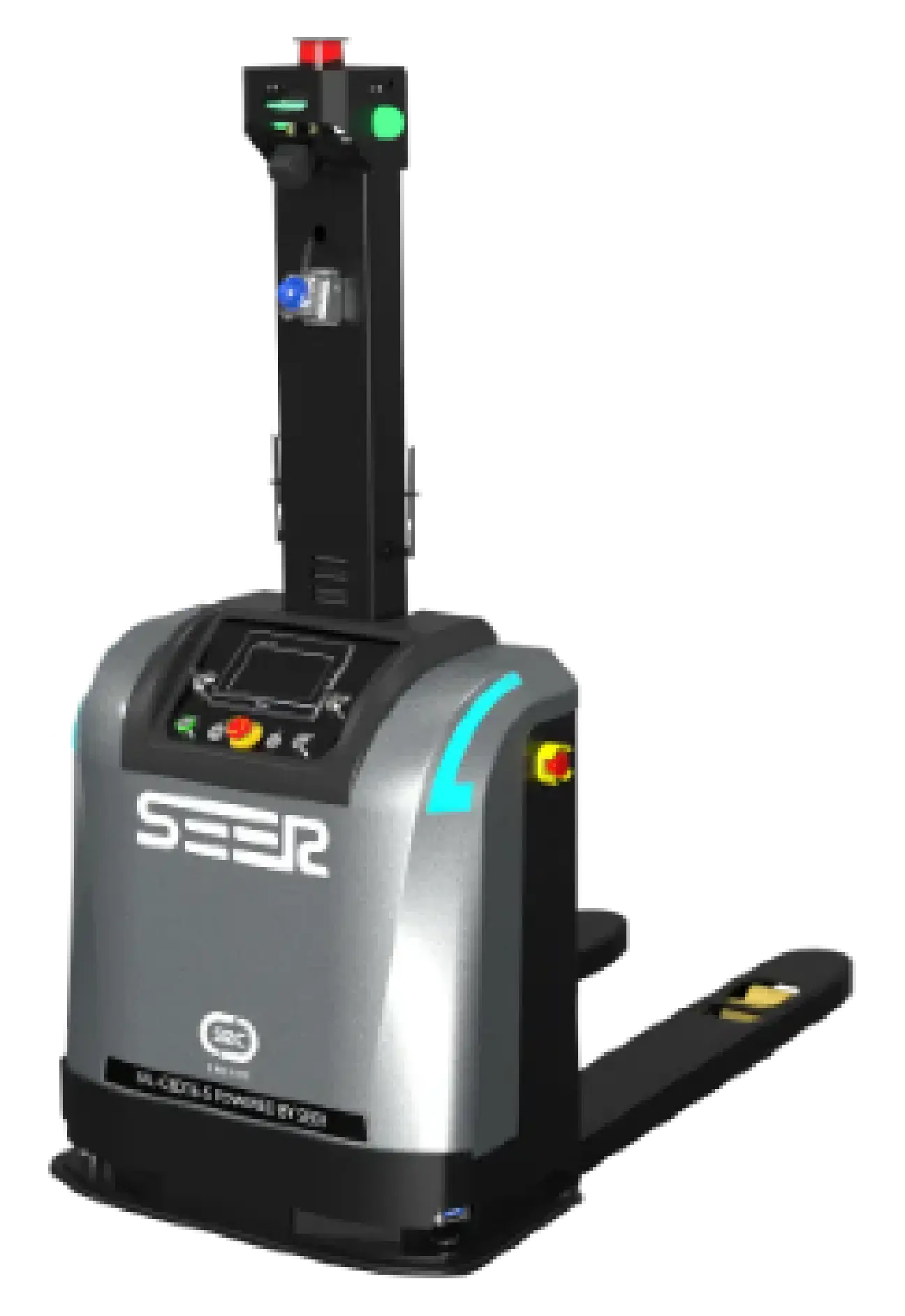
AGV Overview
| Product Name | Laser SLAM Intelligent Transport Forklift |
| Navigation Method | Laser SLAM |
| Pallet Type | Three stringer pallet |
| Rated Load Capacity | 1600 kg |
| Load Center Distance | 600 mm |
| Net Weight (with Battery) | 460 kg |
| Standard Lift Height | 205 ± 5 mm |
| Overall Dimensions: L × W × H (excluding fork tips) | 1681 × 880 × 1896 mm |
| Fork Dimensions: L × W × H | 1220 × 173 × 60 mm |
| Fork Outer Width | 550 / 600 / 680 mm |
| Right Angle Stacking Aisle Width, Pallet 1000 × 1200 (1200 side along fork direction) |
2200 mm |
| Minimum Turning Radius | 1329 mm |
| Operating Temperature Range | 0°C to 50°C |
| Operating Humidity Range | 10% to 90%, non condensing |
| Travel Speed: Loaded / Unloaded | 1.5 / 1.8 m/s |
| Passability (Slope / Step / Gap) | < 5% / 10 mm / 30 mm |
| Navigation Position Accuracy | ±10 mm |
| Navigation Angle Accuracy | ±1° |
| Battery Specification | 51.2 V / 40 Ah (Lithium Iron Phosphate) |
| Endurance | 8 h |
Project Scope and ROI Analysis
Project Scope
| Category | Item | Parameters / Model | Unit | Qty |
| Hardware | Autonomous Transport Forklift | 1.6T, lifting height 20 cm, includes 3D visual calibration, customized forks and height | Unit | 4 |
| Universal Charging Station | Matching charging station | Unit | 2 | |
| Suspended Fire Extinguisher Ball with Bracket | Used with the charging station, 4 kg dry powder suspended fire extinguisher and bracket, optional | Unit | 2 | |
| Accessories | Logistics Central Control System Server | CPU 16 cores / 16 threads, 32 GB memory, 2 TB hard drive, 2U thickness, Linux operating system | Set | 1 |
| Server Rack Cabinet | TOTEN server rack cabinet, 22U, 600 W × 1000 D × 1200 H mm | Set | 1 | |
| Wireless Network Deployment | Covers the AGV working area and connects with the customer’s system | Set | 1 | |
| PDA | Seuic 4 GB + 64 GB, 5 inch screen | Set | 7 | |
| Implementation Kit | Includes printer, tape measure, chalk line tool, straight ruler, debugging cable, wrench set, hex key set, screwdriver set, diagonal pliers, and laser reflector stickers | Set | 1 | |
| System | Scheduling System | Standard forklift scheduling system, plus custom features as needed | Set | 1 |
| Logistics Central Control System | Standard real time monitoring, 2.5D digital twin, task management, equipment management, location management, inventory management, and report management | Set | 1 | |
| Central Control System Customization | Custom rules for zones and storage location allocation | Set | 1 | |
| PDA Customization | Normal functions: location lock and unlock, task list, task cancellation, reset. Exception functions: inventory creation, inventory deletion, manual relocation | Set | 1 | |
| Service | On Site Implementation | AGV deployment and commissioning | Man day | 20 |
| Production Ramp Up Support | Training, guidance, and exception handling | Man day | 10 | |
| Packing and Shipping | Time | 1 |
ROI Analysis
This project is expected to reduce the need for 3 to 5 manual forklifts and 3 to 5 operators. Based on the overall investment and labor savings, the estimated payback period is 2 years.
Payback period = (total project cost minus the total cost of manual forklifts) ÷ total annual labor cost

Interested in our solutions?
- Contact our experts to learn more about Robotlyne’s warehouse solutions.
- See if your project is feasible fast. Get a clear scope, timeline, and Free ROI Analysis.