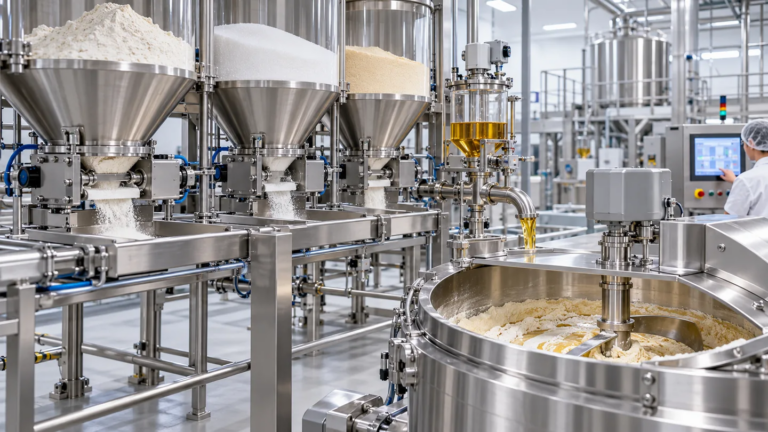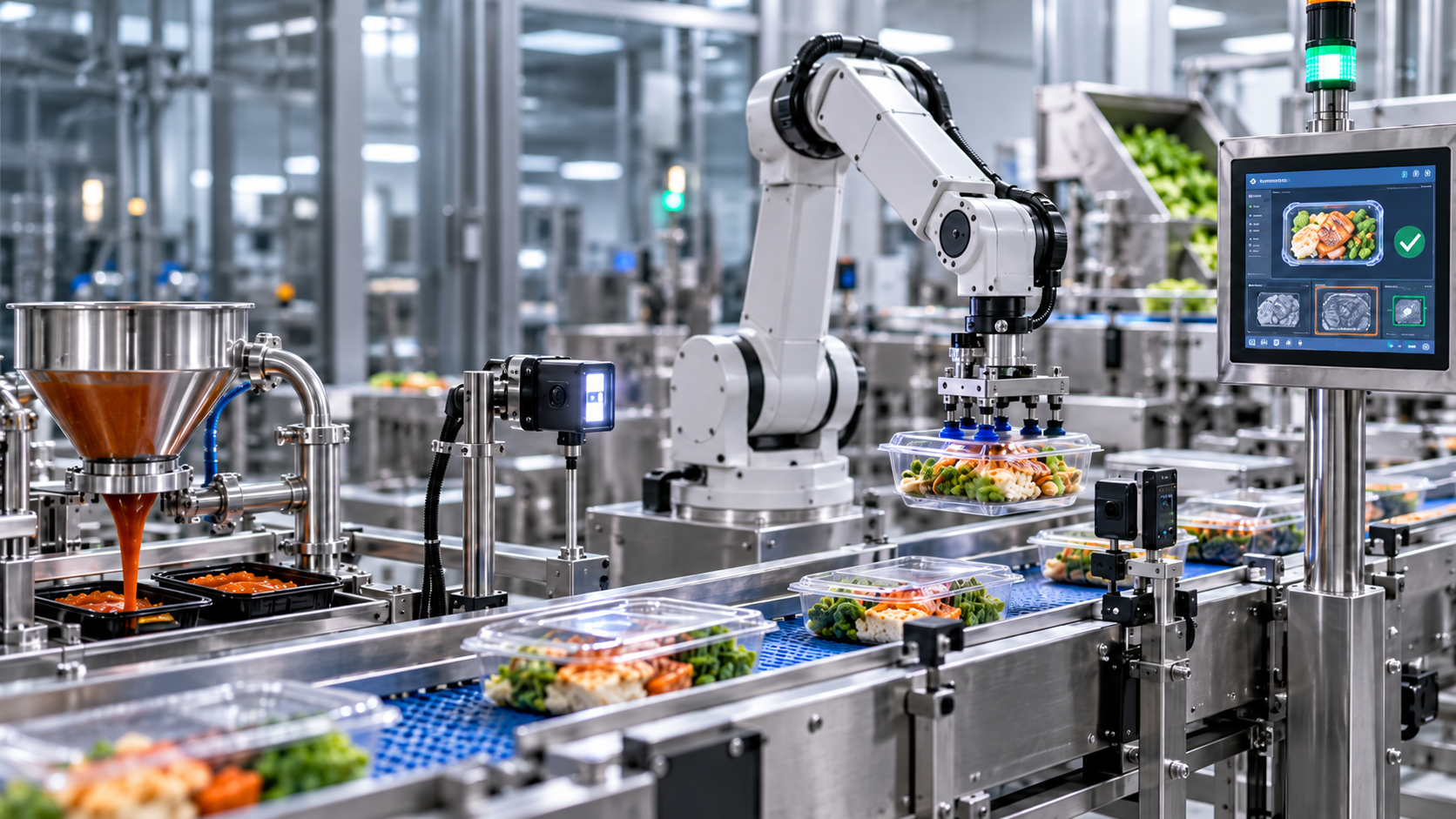
Food processing automation has found its way into ingredient preparation, mixing, processing, inspection, and packaging. Automated weighing and dosing equipment, process control systems, and robots can take over many repetitive tasks, helping food manufacturers follow production procedures more consistently and detect deviations as they occur.
How Does Automation Change Food Processing?
On food production lines that rely heavily on manual work, employees have to weigh and add ingredients batch by batch, adjust equipment settings, and sometimes record processing results by hand. Even with the same recipe, practices can vary from one operator to another.
With automated equipment, recipes can be called up directly, and the system controls ingredient quantities, mixing times, and processing temperatures according to the specified settings. Some equipment can also use inline inspection results to adjust processing parameters—for example, correcting slice thickness or fill volume based on weight feedback.
Production records no longer have to depend entirely on handwritten entries. Equipment with data collection capabilities can save ingredient quantities, processing temperatures, and batch inspection results. If a quality issue arises, production staff can review the actual operating data to see where the deviation occurred.
Operators’ responsibilities change as well. There is less repetitive weighing, ingredient loading, and checking, while equipment monitoring, process adjustments, and troubleshooting become more important.
These changes do not require automating an entire production line at once. An existing food plant can start with a single operation that involves substantial repetitive work or frequent quality variations.
Practical Applications of Automation in Food Processing
Food Packaging Automation
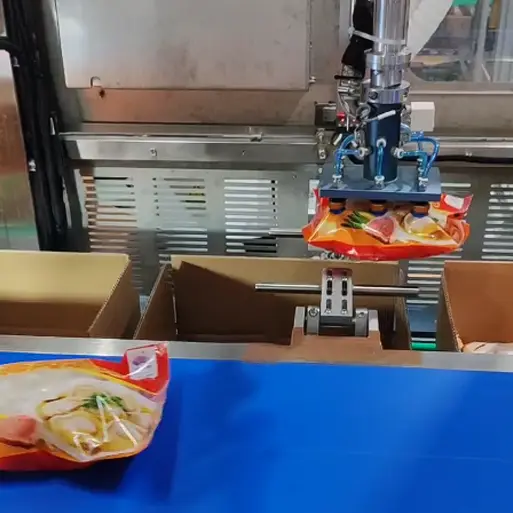
Food packaging involves many repetitive tasks: measuring portions, filling bags, sealing, case packing, and palletizing. Yet a packaging system designed for one food product may need to be redesigned when the product changes.
Powders and granular foods are typically measured into portions before being filled into bags or containers. Liquid foods require control over fill volume. For fragile products such as cookies and cakes, robotic handling must also avoid excessive contact pressure.
Robotlyne designed an automated packaging system for a sandwich manufacturer in the United States. The challenge was straightforward: sandwiches did not all have the same thickness. A gripper with a fixed opening could crush thicker sandwiches or fail to hold thinner ones securely.
To address this, the packaging station uses a robot with adjustable gripping force. It picks sandwiches from a conveyor, rotates them 180°, and places them into dedicated paper bags. The station was designed to handle 20–30 sandwiches per minute.

Seal quality matters just as much before a package leaves the line. Automated sealing equipment must control temperature, pressure, and sealing time. With foods that can leave oil, powder, or sauce around the bag opening, manufacturers also need to account for how that residue may affect the seal.
Food Inspection Automation
If a filling line keeps producing underweight packages, an inline checkweigher can reject them. But removing the underfilled products does not fix a filling system that continues to dispense too little.
When inspection results can be fed back to the processing equipment, some deviations can be corrected during production.
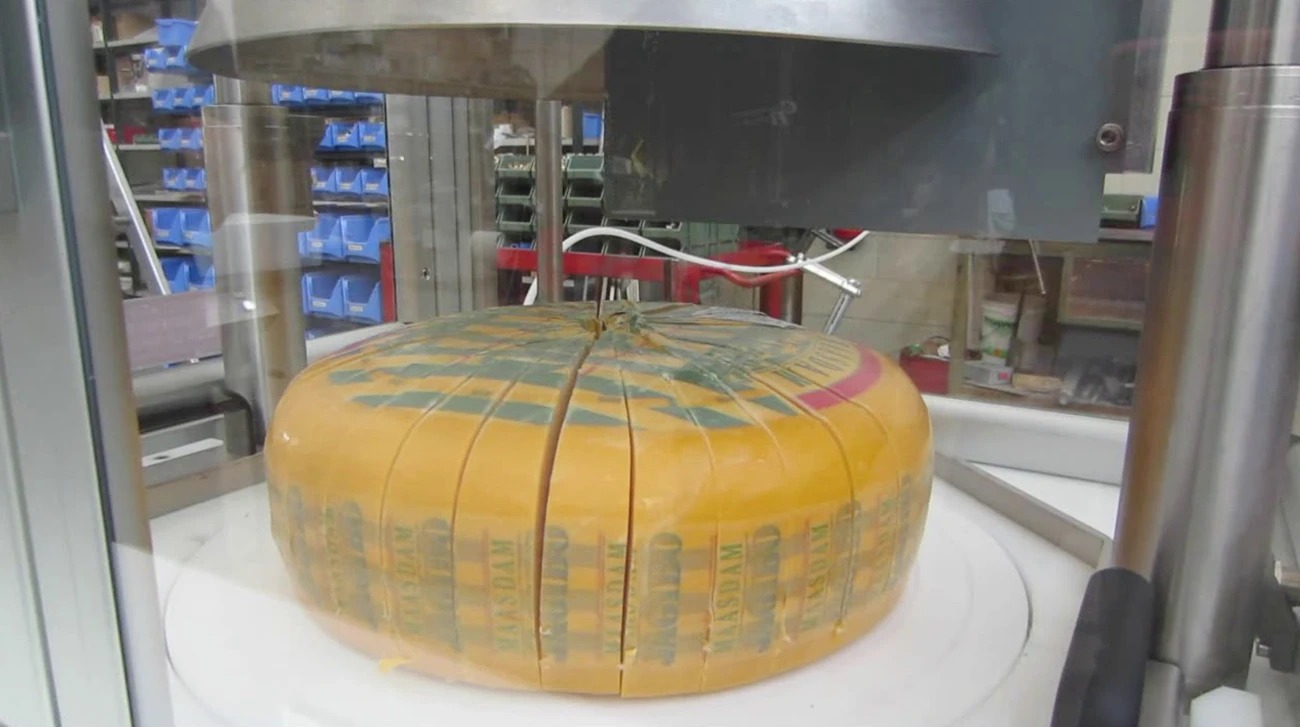
Robotlyne’s automated cheese cutting and packaging project provides an example. The system first measures the cheese and then cuts it into slices. After weighing, the results are fed back to the cutting equipment to fine-tune slice thickness, helping control portion weight and reduce material waste.
Of course, weight is only one aspect of food inspection.
Vision systems can check for misaligned packaging, incorrect label placement, and illegible date codes. Metal detectors primarily identify metal contaminants, while X-ray inspection equipment can detect certain metals, glass, and other high-density foreign objects based on differences in their physical properties relative to the food.
The inspection method needs to suit the product. A technology that can detect one type of defect may not be suitable for another.
Sauce Manufacturing Automation
Automation for Sauce Manufacturing covers ingredient weighing and dosing, loading, mixing, heating, and filling. Recipe control is one of its key functions.
When making ketchup or other sauces, the amounts of individual ingredients, the order in which they are added, and the processing conditions all affect the final product. Automated dosing systems can add ingredients according to the recipe, while the control system manages the specified mixing time, speed, and temperature.
A sauce production line, however, cannot be designed in the same way as a conventional liquid filling line.
Free-flowing sauces are relatively easy to pump through pipes. High-viscosity sauces may require different pumping and filling mechanisms. If a sauce contains fruit pieces, vegetable pieces, or other solids, the passage through pipes and valves must also be considered to prevent blockages or damage to the pieces.
Emulsified sauces have their own requirements. Unsuitable mixing speeds or shear conditions can affect the emulsion and the texture of the finished product.
When a line produces several types of sauce, changing recipes involves more than adjusting a few settings. Equipment often needs cleaning between products with different colors, flavors, or allergens. In plants with frequent changeovers, that time also affects actual production capacity.
Benefits of Food Processing Automation
Improved Product Consistency
Variations in ingredient quantities, processing time, or temperature can affect the quality of the finished food.
Automated dosing and process control systems can repeat operations using the same settings, reducing differences caused by manual weighing and parameter adjustments. For foods with strict weight requirements, accurate portioning can also reduce ingredient waste from overfilling.
Reduced Labor Requirements
Food processing involves many tasks that have to be repeated throughout a shift, including weighing, ingredient loading, product arranging, and packaging. Once suitable tasks are automated, employees no longer have to perform the same motions continuously and can spend more time monitoring equipment, checking quality, and handling exceptions.
Ingredient preparation is a particularly clear example: Automated vs Manual Ingredient Handling differs significantly in operating efficiency, consistency, and the amount of manual involvement required.
Less Product Damage and Waste
Food waste sometimes comes from ordinary operations: a product is crushed during gripping, a package receives a little too much filling, or a poor seal leads to rework.
A suitable robotic gripper can reduce handling damage, dosing controls can limit variations in fill quantity, and a stable sealing process can reduce certain packaging defects.
For plants that run continuously over long periods, cutting these small but recurring losses can save a substantial amount in ingredients and packaging materials.
Better Production Quality Traceability
Once ingredient quantities, processing temperatures, and inspection results are linked to production batches, quality issues can be traced through recorded data.
For example, if a batch has an unusual weight variation, production staff can review the dosing settings and inspection data from that period to determine whether it was an isolated issue or had continued across several batches.
Challenges in Food Processing and How to Overcome Them
Food Hygiene and Equipment Cleaning
Crevices, dead legs in piping, and other hard-to-clean areas on food-contact equipment can increase contamination risks. For production lines that frequently change recipes, cleaning and allergen cross-contact control also become more complicated.
Differences in Food Properties
Cookies can break, soft foods can deform, and sticky products may cling to robotic grippers. Even within the same product, size, weight, and surface conditions may vary. These differences can all affect how reliably automated equipment operates.
Multiple Products and Changeovers
Different flavors, sizes, or packaging formats may require changes to equipment settings, tooling, and cleaning procedures. In plants producing many products in small batches, frequent changeovers can consume a considerable amount of production time.
Retrofitting Existing Production Lines
The available space and equipment layout in an existing food plant are usually already fixed. New automation equipment may be constrained by installation locations, equipment interfaces, and existing processing methods. Changes to certain critical operations may also require process revalidation.
How Can These Challenges Be Overcome?
These issues are best addressed during equipment design rather than one by one after installation. Variations in food size, fragility, cleaning requirements, and changeover frequency all influence the equipment design. For operations with greater uncertainty, such as gripping and conveying, feasibility can first be checked using samples of the actual product. After installation, commissioning and acceptance testing under real production conditions can be used to check continuous-operation stability, cleaning effectiveness, and whether the processing results meet requirements.
How Robotlyne Supports Food Processing Automation
Robotlyne provides food automation solutions covering automated bagging, canning, boxing, case packing, robotic handling, and palletizing. It also offers customized equipment and production line integration based on food characteristics, packaging specifications, and target production capacity.
Robotlyne also offers free project feasibility assessments and ROI analysis to help manufacturers evaluate equipment configurations, potential cost savings, and investment payback periods.