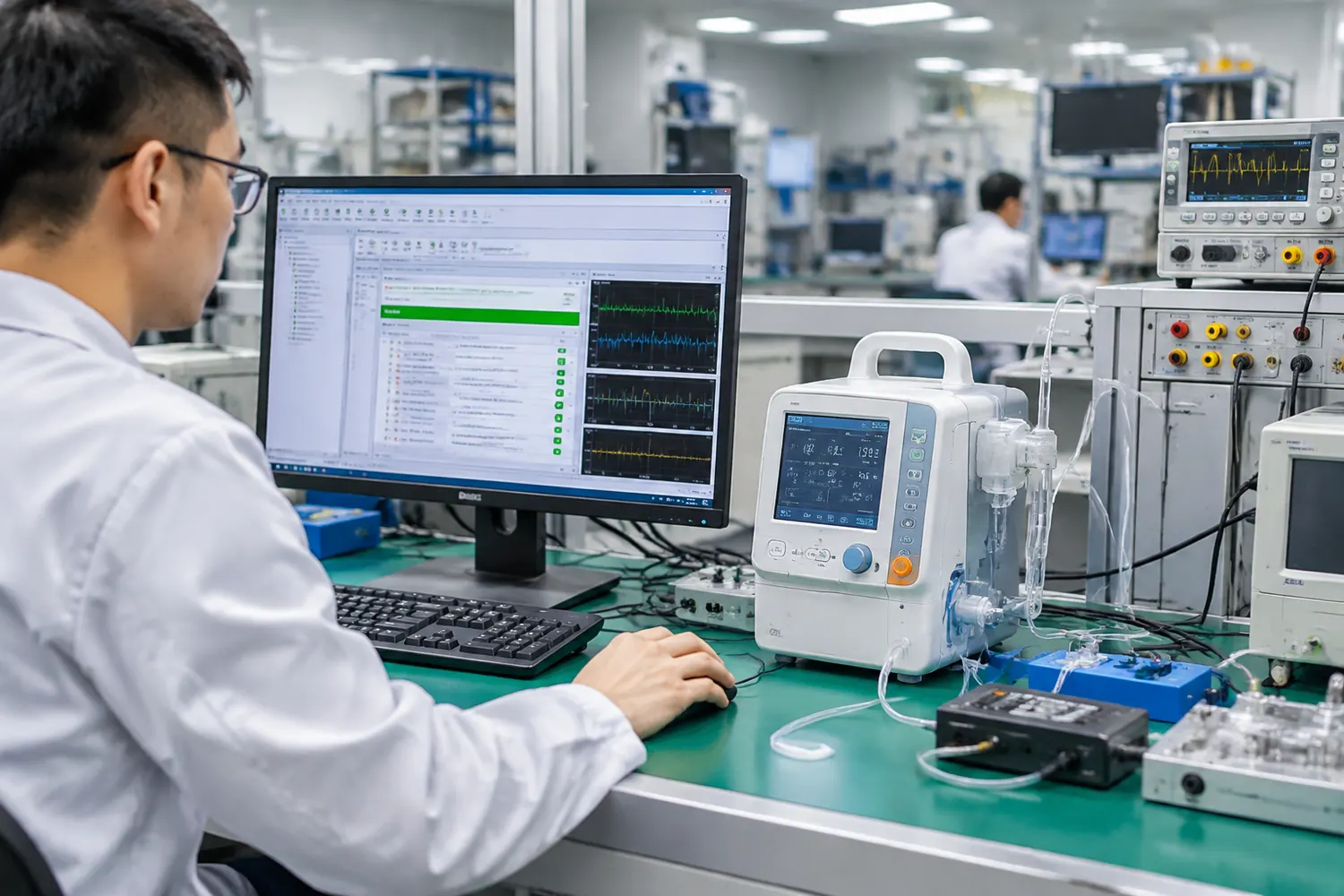
Medical devices cannot all be tested in the same way. Catheters, infusion sets, and medical electronic equipment have different testing priorities: some need leak checks, others require flow and pressure measurements, while still others need electrical performance and software functionality verified.
As product types become more varied, test procedures and methods can become more complex. In volume production, manufacturers also need to manage test time, consistency of results, and test records. Test Automation for Medical Devices brings test instruments, dedicated fixtures, and control software together to run repetitive tests, collect data, and record results.
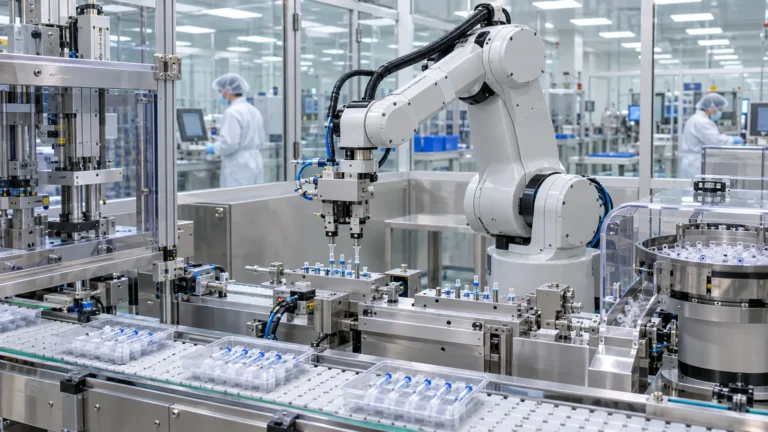
Testing is also an important part of broader Medical Device Automation, alongside component machining and product assembly. Depending on the product, test automation may be used for functional and performance testing of physical devices as well as for testing medical device software.
Challenges in Medical Device Test Automation
1. Different Products Require Different Test Methods
Medical devices vary widely, so their testing methods cannot always be the same.
An infusion pump, for example, may need flow-rate, pressure, and delivery-accuracy checks. Catheters and connectors may require leak, pressure-resistance, or connection-strength tests. Medical electronic equipment, on the other hand, needs electrical performance and functional checks.
These tests use different instruments, fixtures, and measurement principles. Manufacturers need to define the test items according to each product’s actual functions rather than expect one test system to cover every requirement.
2. Keeping Test Results Consistent
Automating a test does not automatically make its results accurate or consistent.
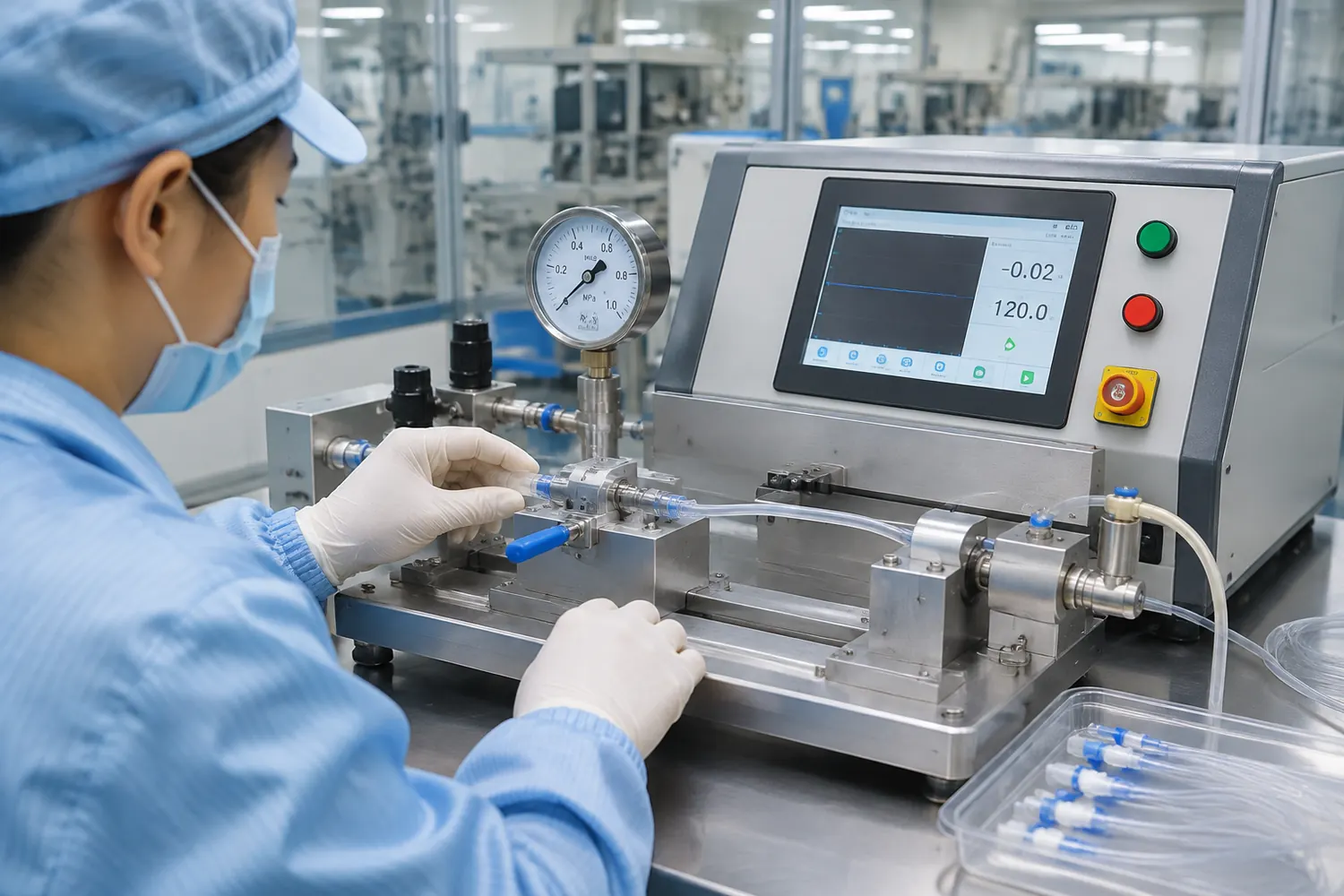
Take catheter leak testing as an example. The connection between the product and the test equipment needs to remain properly sealed. If the fixture does not locate the catheter consistently, or the seal changes each time the product is connected, the measurement can be affected.
Instrument accuracy matters, but so do the fixture, connection interface, test pressure, and surrounding conditions. In volume production, the test setup needs to deliver repeatable results over many cycles.
3. Test Time and Production Throughput
Some medical device tests need to run for a set period before a reliable result can be obtained. Pressure and leak tests, for example, may require the system to hold a specified condition while parameters are monitored.
If each product takes a long time to test, the test station can fall behind the processes before it. Even when assembly equipment has increased output, products may still build up at the testing stage.
One option is to use multiple test stations so several products can be tested at the same time. Another is to split different test tasks across separate stations, reducing the work handled by any one station.
The test items and conditions still need to meet the product requirements. Required tests should not be shortened or removed simply to increase throughput.
4. Coordinating Hardware and Software Testing
Many modern medical devices contain embedded software, sensors, and electronic control systems. Whether a device works correctly depends not only on its hardware, but also on how its software processes input signals and control commands.
For example, testing an infusion device may involve checking its actual flow rate as well as verifying that its control software operates according to the set values. The first is a physical performance test; the second involves software functionality.
Automated Software Testing for Medical Devices can be used for tasks such as unit testing, integration testing, and regression testing. However, software testing does not replace testing the physical device. Products involving sensors, actuators, and control systems still need to be tested as a complete system in the relevant hardware environment.
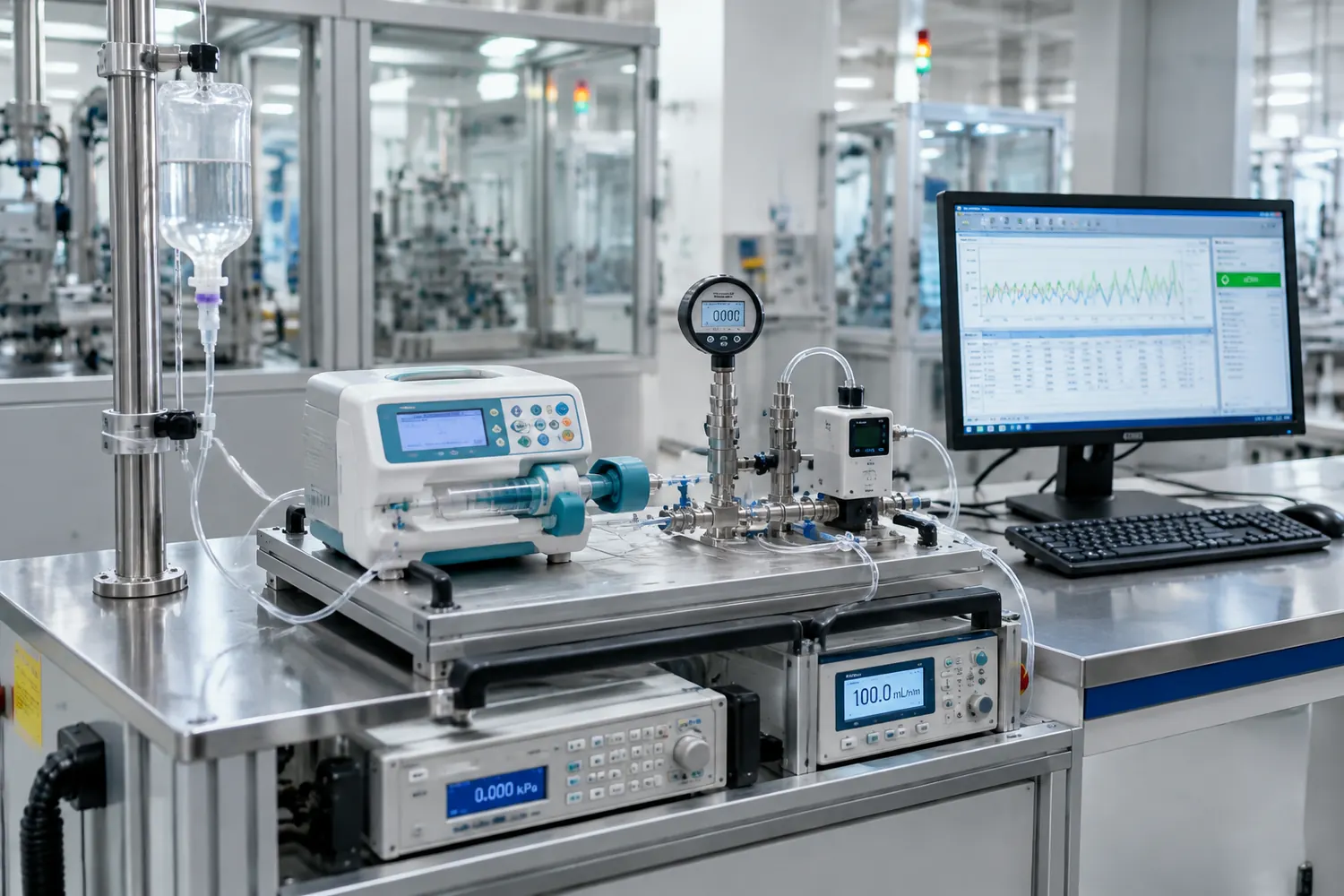
5. Managing Test Records and Traceability
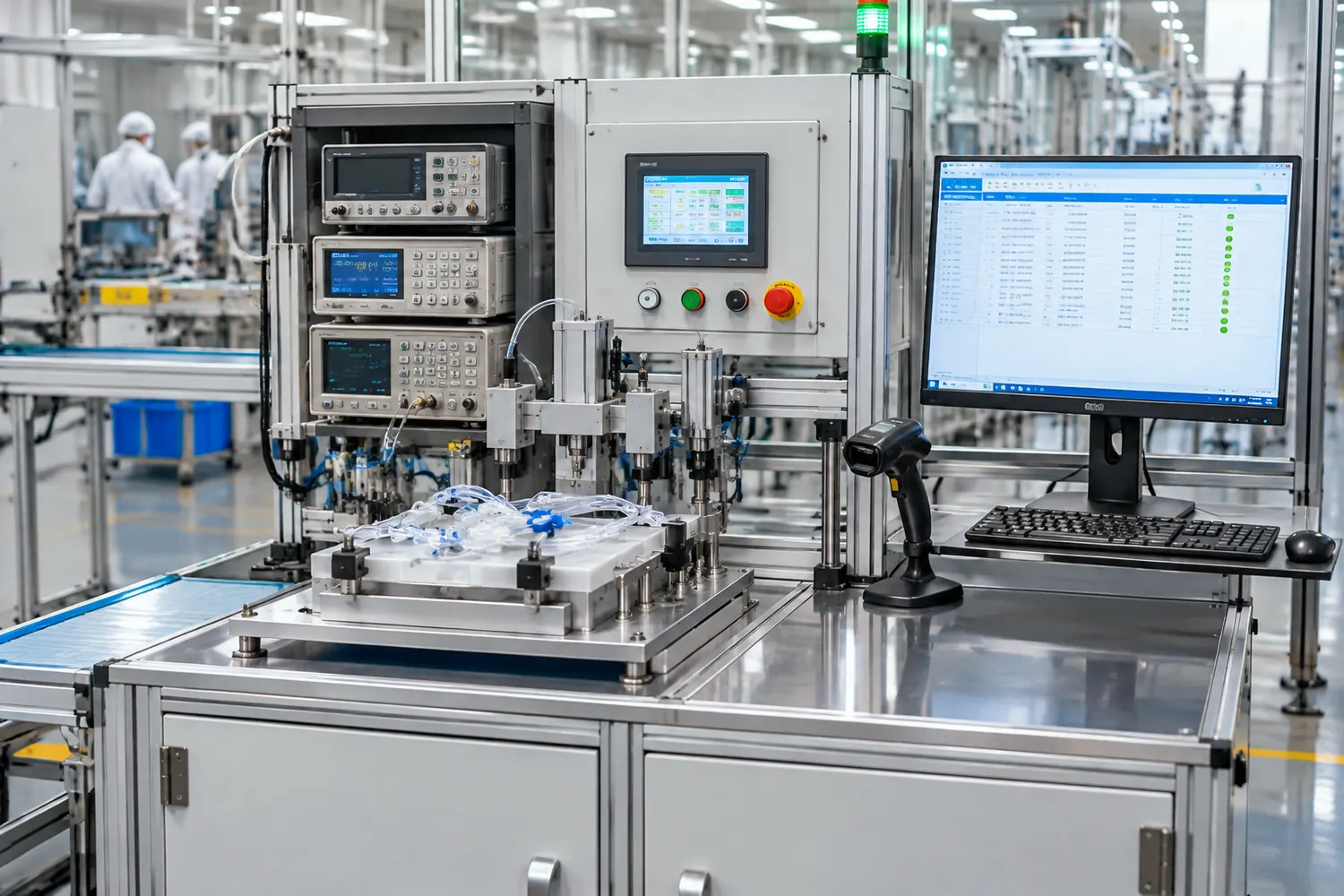
Batch testing generates a large amount of data, including test parameters, measurement results, timestamps, instrument IDs, and pass-or-fail decisions.
If results are stored separately across different instruments or files, finding the record for a particular product can take time. When a test program changes, failing to record its version and test conditions can also make results from different batches difficult to compare.
A test automation system therefore needs to do more than run the test. It should also save the results and associate them with the product serial number or production batch.
What to Prioritize When Choosing Medical Device Testing Tools
Start with what the product needs to be tested for, then look at the equipment’s automation level and system configuration. A test instrument with more features is not necessarily the best fit for a production line.
1. Do the Tools Cover the Required Tests?
First, identify the product characteristics that need to be checked and the method used for each test.
Catheters, for example, may require leak and pressure-resistance tests. Infusion devices need flow-rate and pressure checks, while medical electronic equipment may require electrical performance and functional testing.
The selected instruments should cover the key test items and support the required measurement ranges and conditions. If one instrument cannot handle every test, different measurement modules can be integrated into the same test workstation rather than forcing a single device to do everything.
2. Are Measurement Accuracy and Repeatability Adequate?
When selecting test instruments, check the measurement range, resolution, accuracy, and repeatability. These specifications need to match the actual test requirements of the product.
The fixture and product interface matter as well. Leak testing requires a reliable seal, flow testing needs a suitable flow path, and mechanical testing depends on stable product holding and force application.
Instruments should also have appropriate calibration and performance-check procedures so that measurements remain reliable during long-term use.
3. Can the System Keep Up with the Production Cycle?
If operators have to load and unload every product by hand, testing throughput will still depend on manual work.
For volume production, useful options may include automatic loading and unloading, automatic connection to test ports, programmed test sequences, and automatic sorting of pass and fail products.
When a product needs several tests, a multi-station layout can allow different products to be tested at the same time. The right setup depends on output requirements, test time per unit, and the production line’s cycle time.
4. Can the Tools Connect to Existing Equipment and Software?
Test equipment often needs to communicate with PLCs, robots, MES platforms, or other data management systems.
For physical device testing, check whether test commands, equipment status, and results can be transferred reliably.
For Automated Software Testing for Medical Devices, compatibility with development environments, test management platforms, code version control, and continuous integration workflows also matters.
5. Can Test Data Be Stored and Retrieved?
Test equipment should do more than return a pass-or-fail result. It should also retain the measurement data and test records needed for later review.
For batch production, test results should ideally be linked to the product serial number, production batch, and test program version. When a quality issue occurs, this makes it easier to retrieve the relevant record and compare results across batches.
If the data will be used for formal product verification or quality records, access permissions, record integrity, and review requirements also need to be considered.
6. Will the System Be Easy to Maintain and Expand?
Medical device manufacturers may add new product models, and test requirements can change as product designs are updated.
If the existing test platform can accept different fixtures, adjusted test parameters, or additional measurement modules, a new product size may not require an entirely new test system.
Instrument calibration, software updates, spare parts, and technical support are also worth considering. They all affect how reliably the test system can be used and maintained over time.