Food packaging is one of the final stages of food production. It involves product conveying, weighing, filling, sealing, labeling, case packing, and palletizing. For manufacturers with high production volumes, these operations often need to run continuously. Relying heavily on manual work can increase repetitive labor and make it harder to maintain packaging speed and product consistency.
Automation in Food Packaging connects these steps through automated equipment, conveyor systems, industrial robots, and control software. Depending on the food type, packaging format, and production requirements, manufacturers can automate an individual packaging operation or integrate several steps into a complete automated packaging line.
Food packaging is one downstream stage of broader food processing automation, with its own equipment and production requirements.
What Is Food Packaging Automation?
Food packaging automation refers to the use of automated equipment and control systems to handle a series of operations, from bringing products into the packaging area to final case packing and palletizing. It reduces the need for manual handling, weighing, filling, and packaging.
A typical automated food packaging system includes several types of equipment. Conveyors move products to the required stations, weighing and filling equipment controls the weight or volume of each portion, sealing equipment closes the packages, and robots can handle case packing and palletizing.
Packaging requirements vary from one food product to another. Powders and granular foods need accurate dosing and suitable feeding methods. Liquid foods require precise filling control, while fragile products such as cookies and bread need gentle handling to avoid damage.
In short, food packaging automation is not just about replacing manual work with machines. It is about selecting the right equipment and coordinating each step based on product characteristics and packaging requirements.
What Processes Are Included in Food Packaging Automation?
The exact process flow depends on the product type and packaging format, but a food packaging line typically includes the following steps.
1. Product Conveying and Arrangement
Once food products enter the packaging area, conveyors or other automated equipment move them to the designated stations.
For bulk or irregular products, additional steps may be needed to separate, arrange, and position them so they enter the next process in the right orientation and spacing. Cookies and candies, for example, may need to be arranged before packaging, while some products can move directly to filling equipment.
2. Weighing, Metering, and Filling
At the packaging station, the system determines how much product goes into each bag, bottle, or box according to the packaging specification.
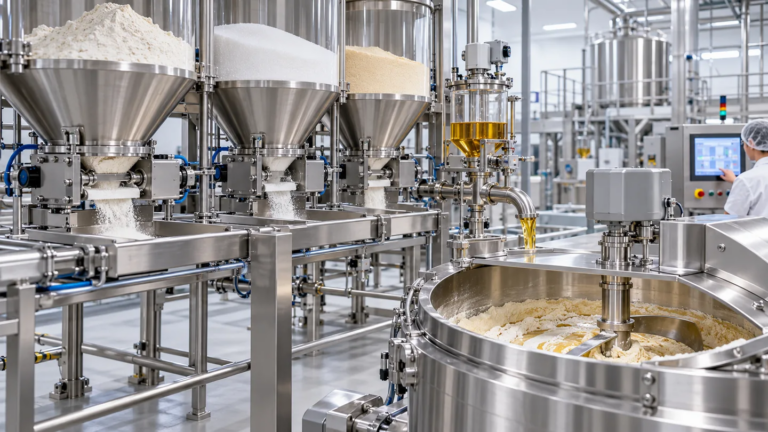
Granular foods and nuts are commonly portioned with automatic weighing equipment. Powdered foods can be dosed with screw feeders, while liquid foods are filled using volumetric or flow-based filling equipment.
For products that require higher accuracy, weighing feedback can be used to adjust the feed amount, helping reduce overfilling and weight variation.

3. Package Forming and Sealing
After metering and filling, the product moves to the packaging forming and sealing stage.
Depending on the packaging format, manufacturers may use form-fill-seal machines, tray packaging machines, bottle filling lines, or other specialized equipment.
Sealing requires control of temperature, pressure, and time. For foods that may leave oil, powder, or sauce residue around the package opening, the effect of that residue on seal quality also needs to be considered.
4. Labeling, Coding, and Package Inspection
After the package is sealed, labels are applied and production dates, batch numbers, or other information are printed.
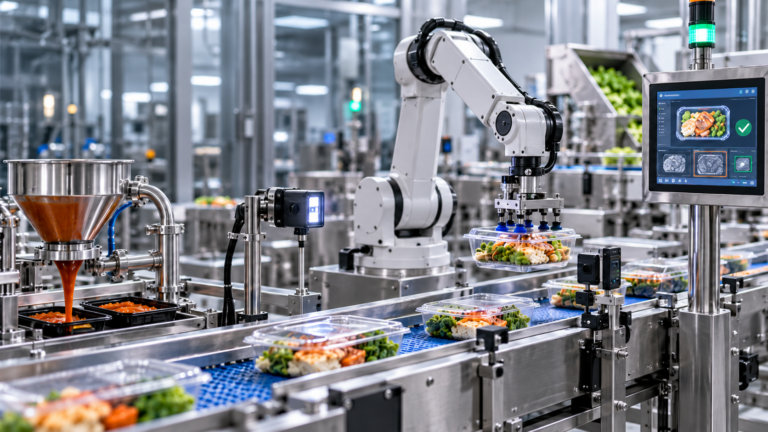
Vision inspection systems can check label position, package appearance, and code clarity. Checkweighers can verify package weight and remove products that fall outside the set range.
These devices can be placed at different points along the line to identify issues during production.

5. Case Packing and Palletizing
After individual packaging, products are usually packed into cartons or reusable totes before palletizing and shipment.
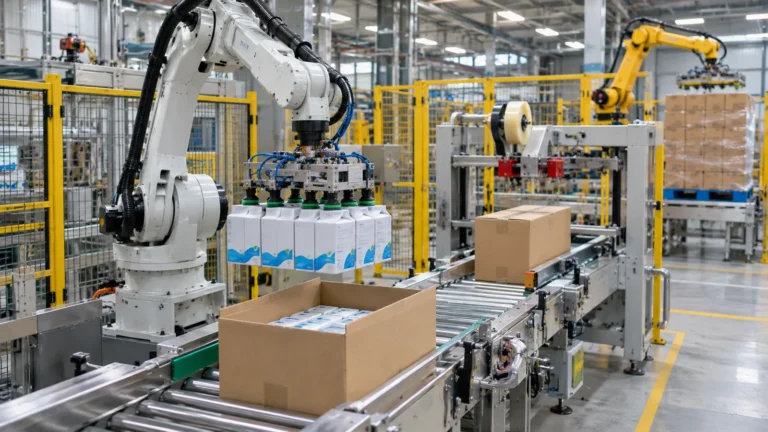
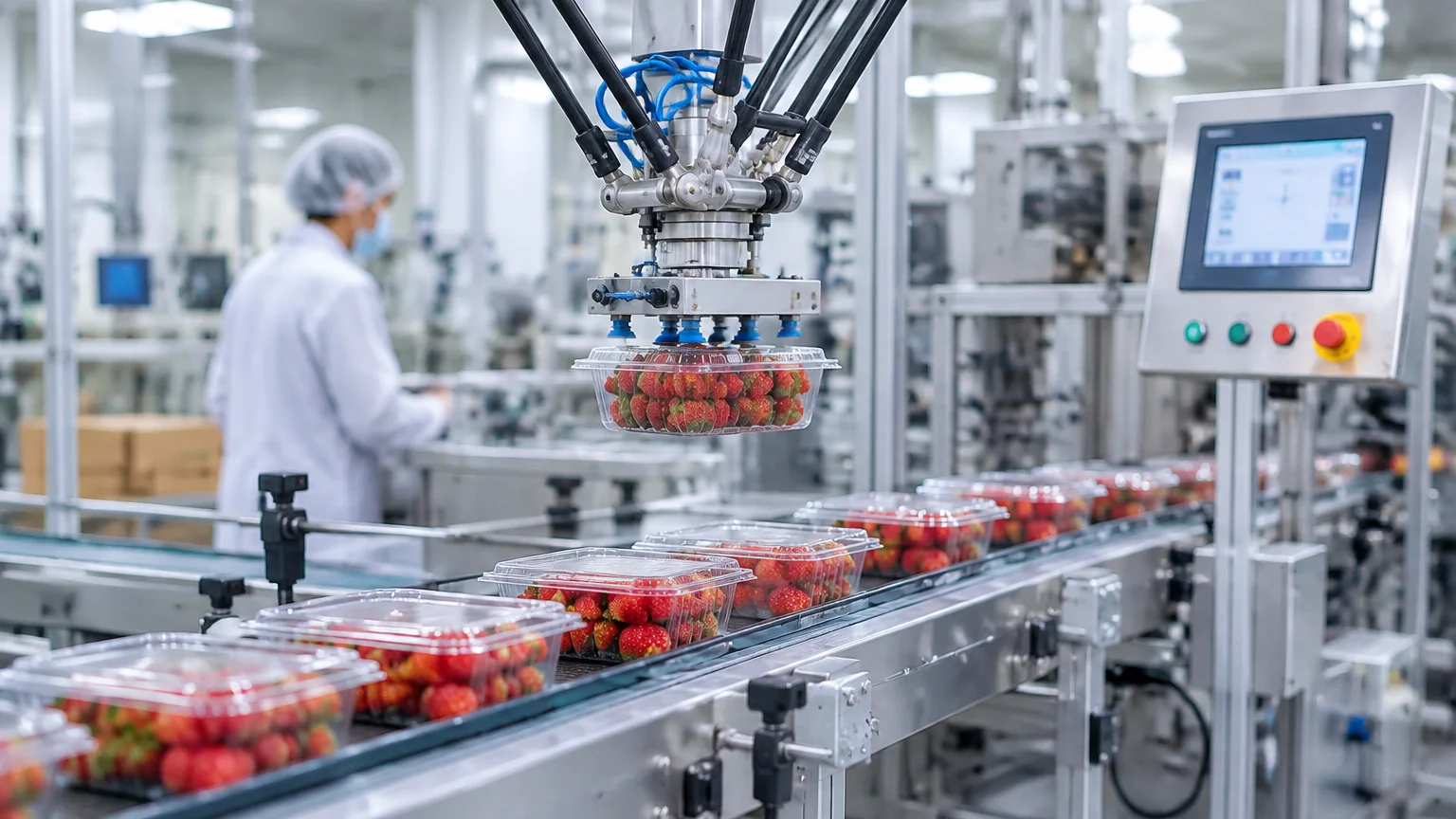
Case packing equipment arranges products and loads them into cartons according to a set quantity. For products of different sizes and weights, industrial robots can handle picking, arranging, and case packing.
At the end of the line, palletizing robots stack cartons onto pallets in a specified pattern, reducing manual handling and repetitive stacking work.
Types of Automated Food Packaging Equipment
A food packaging line is usually made up of multiple types of equipment, configured according to the different process steps.
1. Automatic Weighing and Metering Equipment
Automatic weighing and metering equipment controls the weight or volume of each portion.
Common options include multihead combination weighers, screw feeders, and volumetric filling machines, which are used for granular foods, powders, and liquids respectively.
2. Automatic Filling and Packaging Equipment
This equipment fills food into packaging materials or containers and completes the required packaging operations.
For example, vertical form-fill-seal (VFFS) machines can form bags, fill them, and seal them in a continuous process. Horizontal form-fill-seal (HFFS) machines are suitable for products that need to be conveyed and packaged horizontally.
Bottled, canned, and cup-packed foods may use dedicated filling, capping, or lidding equipment.
3. Automatic Sealing, Labeling, and Coding Equipment
Automatic sealing equipment closes bags, trays, or other containers. Labeling machines apply product labels, while coding equipment prints production dates, batch numbers, and other product information.
These machines can be connected to upstream and downstream conveyors to process packaged products continuously.
4. Automatic Packaging Inspection Equipment
Automatic packaging inspection equipment checks for problems during packaging.
For example, checkweighers verify product weight, machine vision systems identify label-position, appearance, and coding issues, while metal detectors and X-ray inspection systems can be used for foreign-object detection where appropriate.
5. Automatic Case Packing and Palletizing Equipment
Automatic case packers place finished individual packages into cartons according to a preset quantity. Robots can also pick and arrange products based on their shape and required packing layout.
At the end of the line, palletizing robots stack cartons onto pallets. Some systems can also integrate pallet conveyors and stretch-wrapping equipment to reduce manual work further.

Benefits of Food Packaging Automation
Higher Packaging Efficiency
Automated equipment can continuously handle repetitive operations such as weighing, filling, sealing, and case packing, reducing manual work and waiting time between processes.
For production lines that need to run for long periods, matching equipment speeds and workstation capacity helps keep processes coordinated and reduces product buildup in the packaging area.
More Consistent Packaging and Less Waste
Manual weighing, filling, and sealing can vary from one operator to another. Automatic dosing equipment controls the fill amount according to set parameters, while sealing equipment repeats the same sealing process each time.
This helps reduce overfilling, poor seals, and product damage during handling.
Less Repetitive Manual Work
Food packaging involves many repetitive tasks, including product arrangement, case packing, handling, and palletizing.
Assigning these tasks to automated equipment and robots reduces the need for employees to spend long periods picking, bending, lifting, and stacking. Staff can focus more on equipment monitoring, quality checks, and production management.
Better Packaging Quality Management
Automated packaging systems can combine weighing, vision inspection, and other checks to identify weight deviations, labeling errors, and package appearance issues in time.
Some equipment can also store production parameters and inspection results, making it easier for production teams to review problems during packaging.
Flexibility for Different Products and Packaging Formats
Food manufacturers may need to produce different flavors, weights, and packaging formats. Adjustable grippers, packaging molds, and control programs allow some automated equipment to handle different product specifications.
For lines with frequent product changeovers, equipment design should also take changeover time, cleaning requirements, and switching between packaging materials into account.
If you are planning to automate your food packaging line, Robotlyne can help evaluate your production requirements and develop a suitable automation solution. Contact our team to discuss your project.