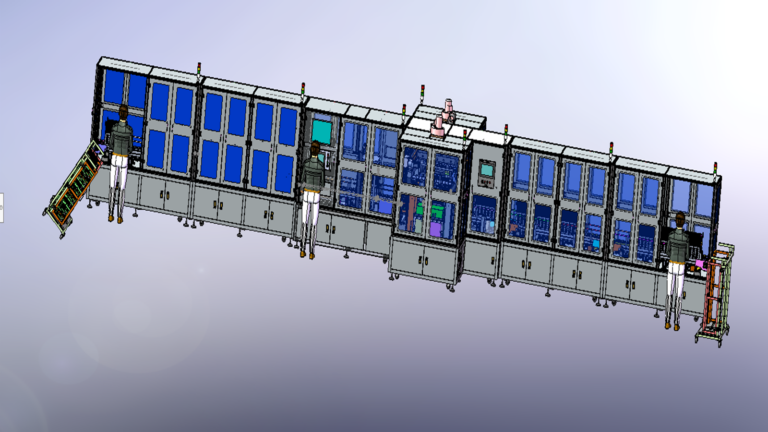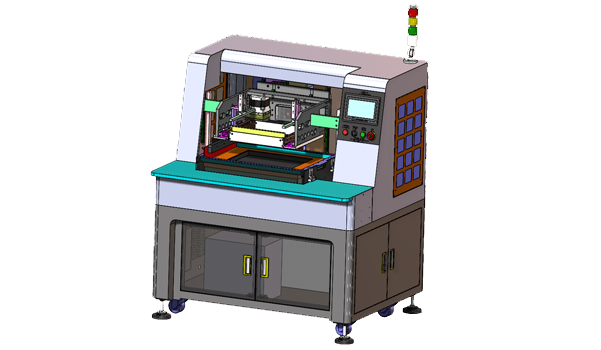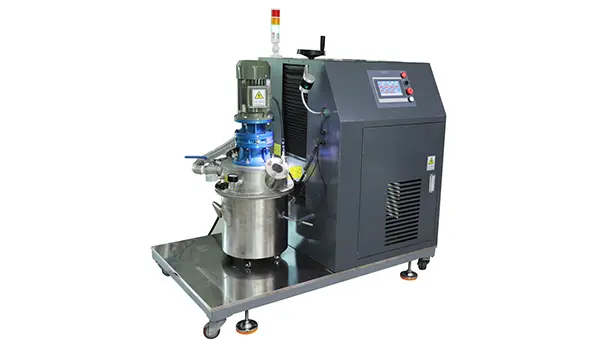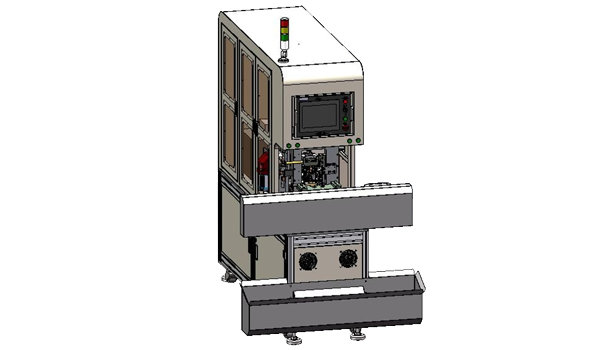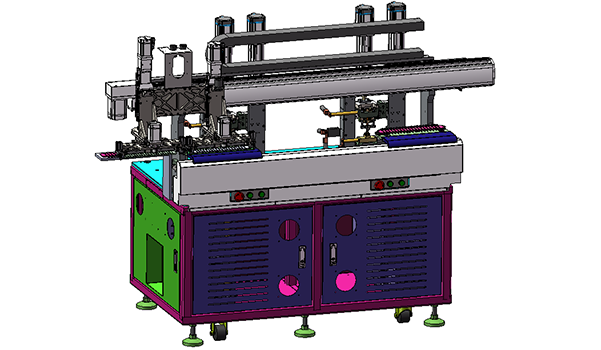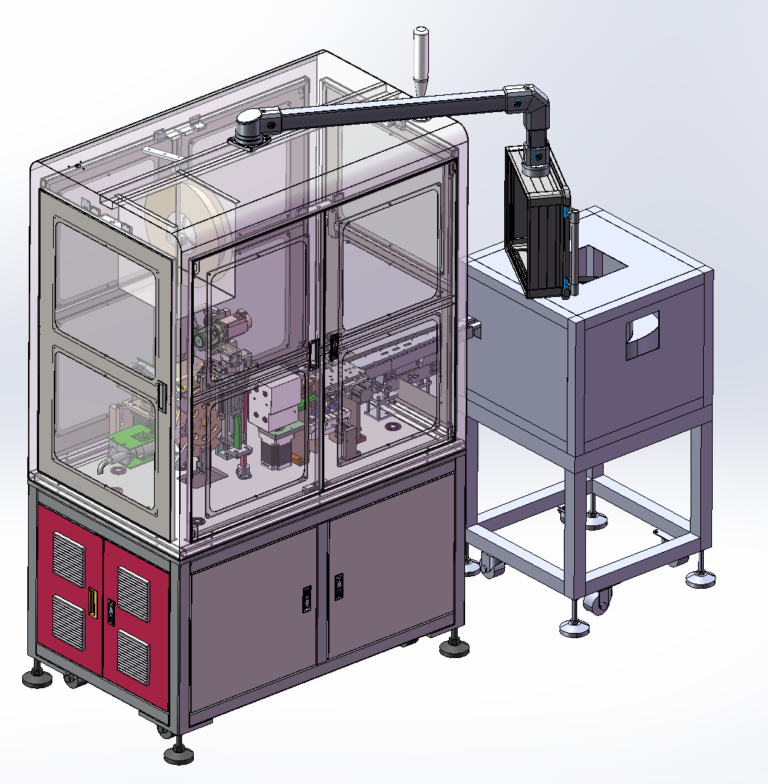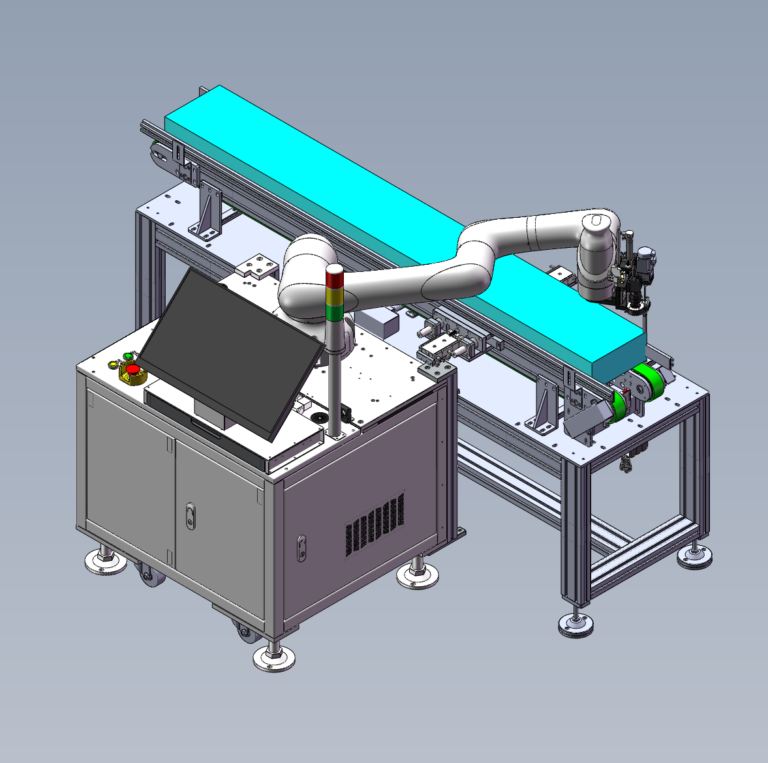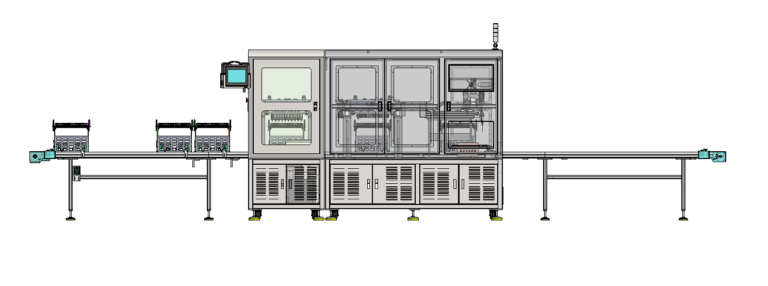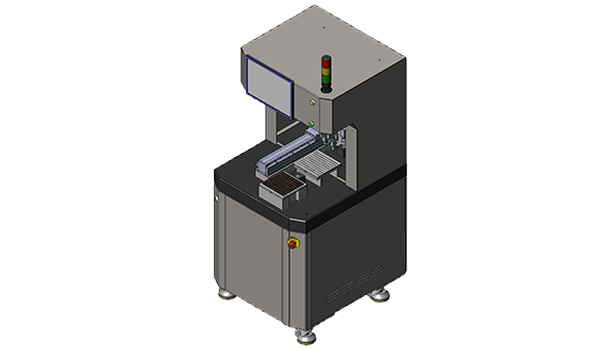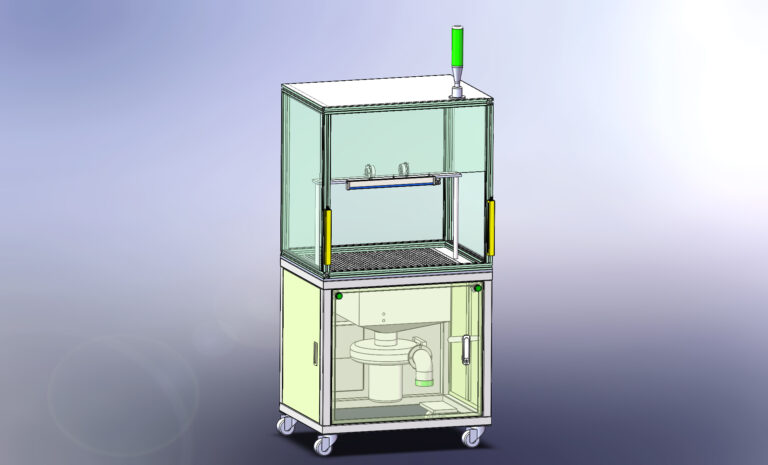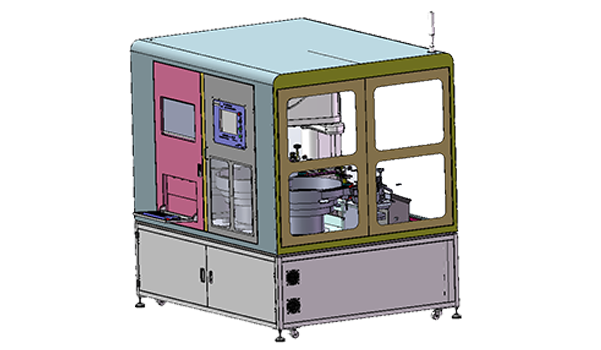
In Home Appliance Component manufacturing, Lead Forming systems do not necessarily need Feeding, Forming, and Handling to share the same mechanism. In this Three-Bowl Four-Axis Forming Cell project, Robotlyne integrated three Vibratory Bowl Feeding Positions, three independent Forming Stations, one Four-Axis Robot, and one Finished-Product Area into a single Enclosed Machine. The three material paths remain independent through Feeding and Forming. Shared Handling begins only when parts need to move between fixed process positions.
This architecture sits between three fully independent machines and a design in which every mechanism is shared. Each path keeps its own Feeding Source and Forming Position, preventing the three process routes from being merged at the front end. Once the relevant forming operation is complete, the shared Robot connects the Feeding, Forming, and Finished-Product Positions. The result is a guarded forming cell with all major mechanisms contained within one machine boundary.
Robotlyne’s Electronics Assembly Automation covers Automated Part Handling, Standalone Machines, Semi-Automated Equipment, and Robotic Workcells for Electronics and Home Appliances, including component-automation projects that integrate Feeding, Forming, and Robotic Transfer into a single machine.
The Three Feeding Paths Remain Independent from the Start
The front end of this Cell has three Vibratory Bowl Feeding Positions.
Each Bowl serves its own Feed Stream:
Vibratory Bowl 1
Vibratory Bowl 2
Vibratory Bowl 3
The three material streams then enter their respective process paths inside the machine. Robotlyne did not merge the three Feeding Sources into one Shared Feeder and then rely on a switching mechanism to decide which material route should run next.
Each Feed Stream therefore has its own boundary from the moment it enters the Cell.
A Bowl can continue feeding according to the behavior of its own component.
Its corresponding Feeding Path also does not need to share the same outlet with the other two material streams.
If one component type differs in orientation, size, or Feeding Behavior, that variation can remain inside its own Feeding Section rather than being introduced first into a shared Material Presentation Mechanism.
The three Feeding paths continue into three separate forming positions:
Forming Station 1
Forming Station 2
Forming Station 3
From a production-architecture perspective, the front half of the machine therefore behaves like three dedicated process paths operating in parallel:
Feed Stream 1 → Forming Position 1
Feed Stream 2 → Forming Position 2
Feed Stream 3 → Forming Position 3
The Forming Function is not forced into a single Universal Forming Station simply because the three mechanisms are installed inside the same machine.
Each forming position remains mechanically fixed.
The actual forming conditions stay within the dedicated Station, rather than requiring one universal mechanism to continually change its mechanical state to cover all three paths.
Shared Handling Begins After Forming
Keeping the three process paths independent does not require three complete unloading and transfer systems.
The shared resource appears in the Handling stage.
Robotlyne uses one Four-Axis Robot to coordinate part movement between the Feeding areas, the three Forming Positions, and the Finished-Product Area.
The shared function is not the Forming Process.
The shared function is:
Transfer Task
After Forming Station 1 completes its mechanical operation, it does not need a dedicated Robot or Transfer Module just to move the part to the next position.
The same applies to Forming Stations 2 and 3.
One Four-Axis Robot can handle these movements around the fixed Station Positions.
The machine therefore contains two different resource relationships.
The following remain independent:
- Three Vibratory Bowl Feed Streams
- Three Forming Positions
The following begin to share resources:
- Part handling between stations
- Transfer to the Finished-Product Area
If Feeding were also shared, one front-end mechanism would need to handle three different Material Streams.
If Forming were also shared, one forming mechanism would need to switch between different mechanical conditions.
In the current architecture, those operations stay in dedicated positions.
Sharing begins only when a part needs to move from one fixed position to another.
The Four-Axis Robot therefore does not need to perform the process functions of every station. It connects the three dedicated Forming Positions and repeats the Handling tasks between them.
This separation allows the Robot to focus on transfer, while each Forming Station continues to work around its own Tooling and Process Position.
One Shared Robot Brings Three Independent Paths into One Enclosed Cell
Once Feeding and Forming remain independent, giving each path its own complete Transfer and Collection Structure would cause the machine to expand in three separate directions.
By concentrating Handling around one Four-Axis Robot, Robotlyne can arrange the three paths around a shared Robot Work Area.
The resulting layout is straightforward.
The three Feeding Sources remain around the perimeter.
Three Forming Stations remain fixed inside the Cell.
The Four-Axis Robot is positioned within a working range that can serve those locations.
Completed parts are delivered to one Finished-Product Area.
The Cell can be represented as:
3 Independent Feed Streams
↓
3 Dedicated Forming Positions
↓
1 Shared Handling Resource
↓
1 Finished-Product Area
The shared resource reduces duplicated Handling Hardware rather than reducing the number of dedicated forming functions.
All three process paths still exist.
Sharing starts at the point where parts need to move between them.
Robotlyne can therefore place Feeding, Forming, Robot Handling, and Finished-Product Collection inside one Guarded Frame without building a complete loading and transfer system for every Forming Route. The project is planned as one enclosed forming machine, with the three Feeding paths, three Forming Positions, and robotic Handling contained within the same machine boundary.
In this Cell, the three material paths remain independent through Feeding and Forming, while only downstream Handling is shared.
For Home Appliance Component production with multiple Vibratory Bowls, several dedicated Forming Positions, and manual transfers between stations, contact Robotlyne to evaluate which Process Positions should remain independent and which Transfer Actions can be consolidated into one shared Robot Cell.