An e-commerce warehouse rarely packs the same product all day. One order may contain just a piece of clothing, while the next includes books and several small electronic products. Different quantities, dimensions, and protection requirements call for different packaging methods.
When a warehouse processes thousands of orders a day, packing can become one of the stages that holds up shipments. Even if picking is fast, orders may still pile up in the packing area when staff have to select boxes, pack items, add cushioning, and seal each shipment by hand.
Packaging automation for e-commerce uses packaging machinery and robots to handle these repetitive tasks, with conveyors and control systems coordinating the workstations. Warehouses with a wide range of order sizes also need equipment that can change formats or adjust packaging dimensions.
How Does E-commerce Packaging Automation Differ from Traditional Packaging Lines?
E-commerce packaging automation covers packaging preparation, product packing, protective cushioning, sealing, and labeling. Equipment can be introduced at an individual workstation or integrated into a continuous packaging line.
Traditional manufacturing packaging lines are generally organized around product specifications and production batches. A line might package hundreds of identical products in succession, then switch to a different packaging format when the batch is complete.
E-commerce fulfillment centers handle products from many different orders, and packaging requirements can change from one order to the next. A single-item order may fit in a mailer, while an order containing several items needs a carton. Fragile products may also require cushioning and careful placement inside the box.
These differences affect equipment selection. A fixed-format case erector is suited to warehouses that use standard cartons continuously. Facilities with widely varying order dimensions may benefit more from on-demand box-making equipment or machines that adjust carton dimensions automatically.
The degree of automation can vary, too. Some warehouses automate case erecting, sealing, and labeling while workers place products into boxes. Others use robotic case packing and automatic cushioning systems. How much of the process can be automated depends closely on product size, shape, and packaging requirements.
Types of E-commerce Packaging Automation Equipment
1. Automatic Case Erectors and On-Demand Box-Making Equipment
An automatic case erector takes pre-cut, folded corrugated cartons, opens them mechanically, and seals the bottom.
It takes over the repetitive work of picking up flat cartons, opening them, and sealing their bases. In warehouses that use a few standard box styles, a case erector can keep packing stations supplied with ready-to-fill cartons.
Standard box sizes, however, will not suit every order. If a customer orders a book and a small electronic accessory, a large standard carton may leave a lot of empty space that needs additional void fill.
On-demand box-making equipment offers another approach. It uses product dimensions or dimensions calculated for the order to produce a suitably sized carton. Some systems can also reduce box height after the products have been packed, limiting unused space.
The chosen box dimensions still need to account for how items are arranged and how much protective cushioning is required. The outer dimensions of the products alone do not determine the finished box size.
2. Automatic Case Packing and Cushioning Equipment
Placing products into a carton may look straightforward, but it is often one of the harder packing tasks to automate in an e-commerce warehouse.
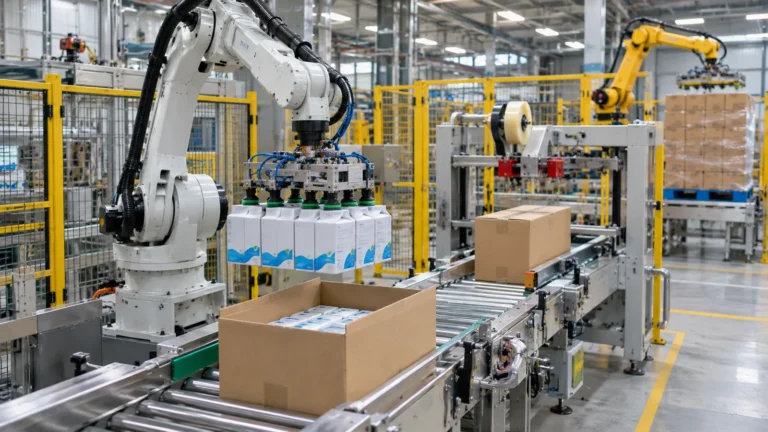
For products with consistent dimensions and regular shapes, robots can use vacuum cups, grippers, or other end effectors to pick and pack items. Some systems also use machine vision to identify the position and orientation of each product.
The difficulty increases as the product mix changes. Picking up a boxed electronic accessory can require a very different grip and placement motion from handling glassware, soft clothing, or a combination of irregular items. Fragile products must also be handled without excessive force.
Many warehouses therefore use semi-automated packing stations: machines prepare the cartons, workers load the items, and automated equipment handles sealing and labeling.
Cushioning is another important step. Paper void fill, air pillows, and other protective materials help limit movement inside a carton during shipping. Automatic dispensing or filling equipment can supply cushioning material according to preset requirements, reducing manual material handling and cutting.

3. Automatic Bagging and Poly Mailer Packaging Equipment
Not every e-commerce order is shipped in a carton. Clothing, towels, and some other products that are not easily damaged can be packed in plastic or paper mailers.
Mailers are lightweight and take up less space, making them a common option for products that do not need the structural support of a box.
Automatic bagging machines can feed bags, open them, and seal them. Some models also load the products automatically and adjust the bag length to suit the items.
For flexible products such as apparel, bagging machines can reduce the time spent retrieving, opening, and sealing mailers. With manual loading, workers place the products in a designated position and the machine performs the remaining steps.
Mailers are not suitable for everything. Products that are easily crushed, have sharp edges, or need additional impact protection require packaging materials selected for their shipping conditions.
4. Automatic Case Sealing and Labeling Equipment
Case sealing and labeling are relatively easy packaging tasks to standardize, so they are often among the first operations a warehouse automates.
Automatic case sealers close cartons using tape or hot-melt adhesive. Lines handling several box sizes can use machines that adjust their working width and height automatically or as required.
Each shipping label must match the specific parcel. Labeling equipment receives order or shipping-label data, prints the label, and applies it to the carton or mailer.
A poorly placed label or unreadable barcode can prevent a parcel from being identified correctly in downstream automated sorting. Some packaging lines therefore include scanners or vision systems to check labels and barcodes.
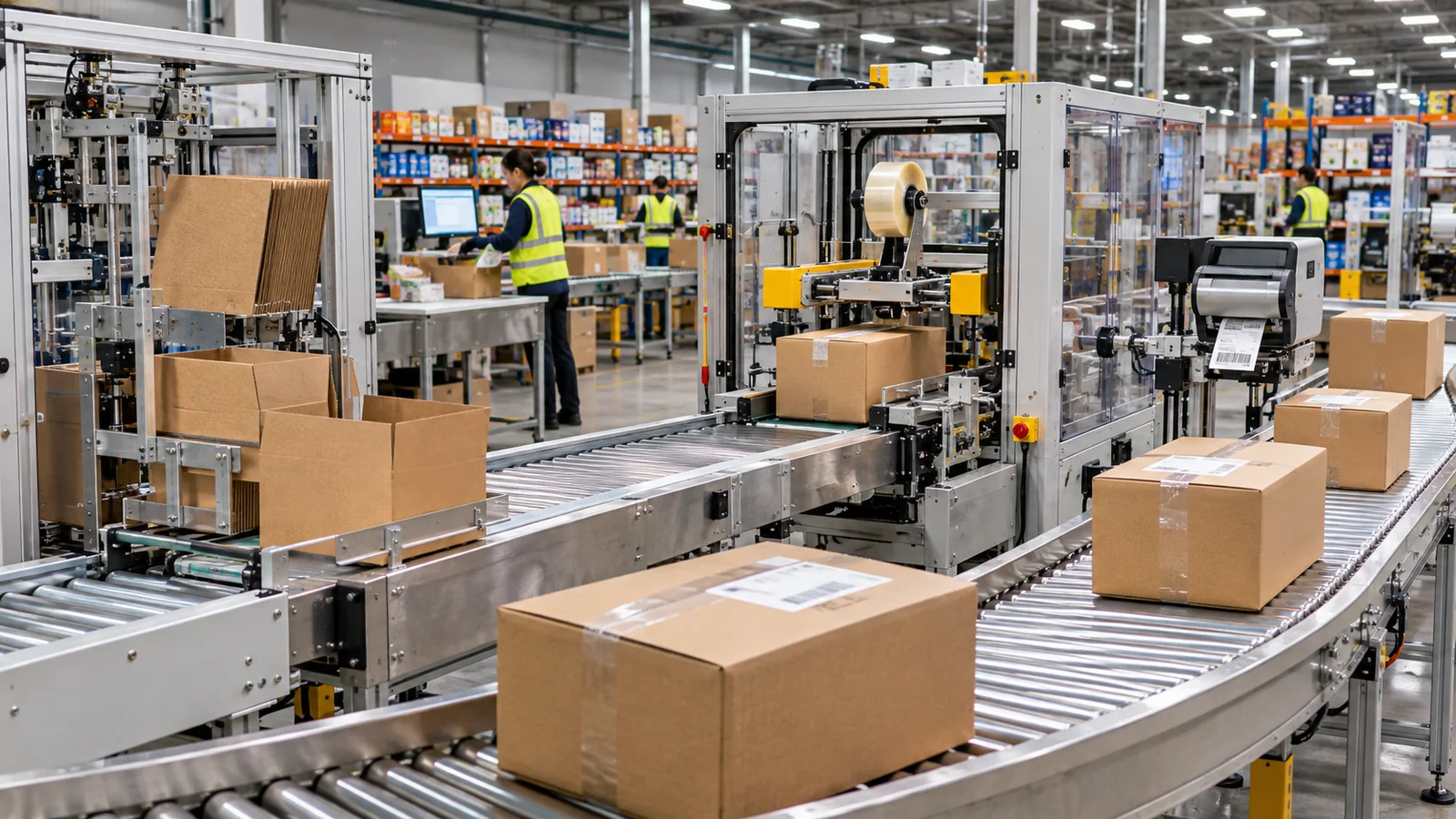
Case sealers, labelers, and other equipment can be connected by conveyors to create an integrated automated packaging system, reducing manual handling between workstations.
How Are E-commerce Orders Handled on an Automated Packaging Line?
A packaging line receives physical products along with their associated order information. Carton size, workstation assignment, and shipping-label details need to match the current order for the packaging process to run correctly.
Determining the Packaging Method from Order Information
Packing generally begins with checking the order’s packaging requirements.
The system can read the item quantity, dimensions, weight, and preset packaging rules to determine whether to use a carton or mailer and which packaging size is appropriate.
Warehouses using on-demand box-making equipment also need dimensions for the products or the combined order. Those measurements may come from product master data or from dimensional-measuring equipment.
Orders with several items are more complicated than single-item shipments. Arranging the same products in different ways can require different box sizes. Fragile goods also need enough room for protective cushioning.
Moving Products to the Packing Station
Picked products generally reach the packing area by conveyor or another material-handling system.
For orders packed as a single shipment, the system should first confirm that all required items are present and that the product information and quantities are correct. Orders can then move to an appropriate packing station.
If the line has both automatic case-packing stations and manual packing stations, tasks can be routed according to product characteristics and order requirements.
Regularly shaped items that are suitable for mechanical handling can go to a robotic packing station. Irregular products and orders needing special protection can be handled by workers. Robotic case packing also requires the machine to identify the actual position and orientation of each item before gripping and placing it.

Completing Packaging and Checking Parcel Information
After the products are placed in a carton or mailer, the line carries out the required sealing, labeling, and related operations.
Before the parcel leaves the packing area, the system can use barcode scanning, weighing, or vision inspection to check the packaging result.
For example, if an order contains three items but the finished parcel weighs significantly less than expected, the system can divert it to an exception-handling station so staff can check for missing items or other problems.
A weight check cannot catch every packing error. Depending on the operation, item scanning, order verification, or other checks may also be needed.
Parcels that pass inspection continue to downstream conveying and shipping, while parcels with packaging exceptions are held for review.
What Are the Benefits of Packaging Automation for E-commerce?
Higher packing-station throughput
Manual packing involves retrieving boxes, opening them, loading products, adding cushioning, sealing cartons, and applying labels. Workers may also have to switch materials and methods from one order to the next.
Automatic case erectors, sealers, and labelers take over many of these repetitive operations. In higher-volume warehouses, they can continuously supply cartons and process packed parcels.
When products still need to be loaded by hand, the speed of manual packing also limits the throughput of the line. Actual capacity therefore needs to be assessed across all workstations.
Less unnecessary packaging material
With standard cartons, small products may end up in boxes that are much larger than necessary. This uses more corrugated material and often requires additional void fill.
On-demand box-making and box-size adjustment equipment can bring packaging dimensions closer to the actual order requirements, reducing some of the board and cushioning material consumed.
Parcel dimensions can also affect shipping costs. Where carriers use dimensional-weight pricing, a smaller parcel may reduce the cost of certain shipments, depending on the carrier’s pricing rules and the product weight.
More consistent packaging quality
Manual sealing, cushioning, and labeling can vary between workers. The amount of protective fill, tape placement, and label position may differ from parcel to parcel.
Automated machines repeat sealing, labeling, and other packaging tasks using set parameters, helping to maintain consistent results. Scanning and vision checks can also identify certain label errors, barcode issues, and visible packaging defects.
Less dependence on extra labor during order peaks
During promotions, a warehouse may receive far more orders than on a typical day.
If every packing task is manual, increasing capacity often means bringing in more staff temporarily. Case erecting, sealing, and labeling machines can take on part of this repetitive work and reduce the need for additional manual labor.
Manual assistance is still valuable for fragile items, large irregular products, and unusual item combinations. Running common orders through automated equipment while retaining manual capacity for special cases can give the warehouse more flexibility.
If you are planning to upgrade your e-commerce packing stations, Robotlyne can help assess packaging equipment and system integration options based on your products, packaging formats, and target throughput. Contact us to discuss your project.