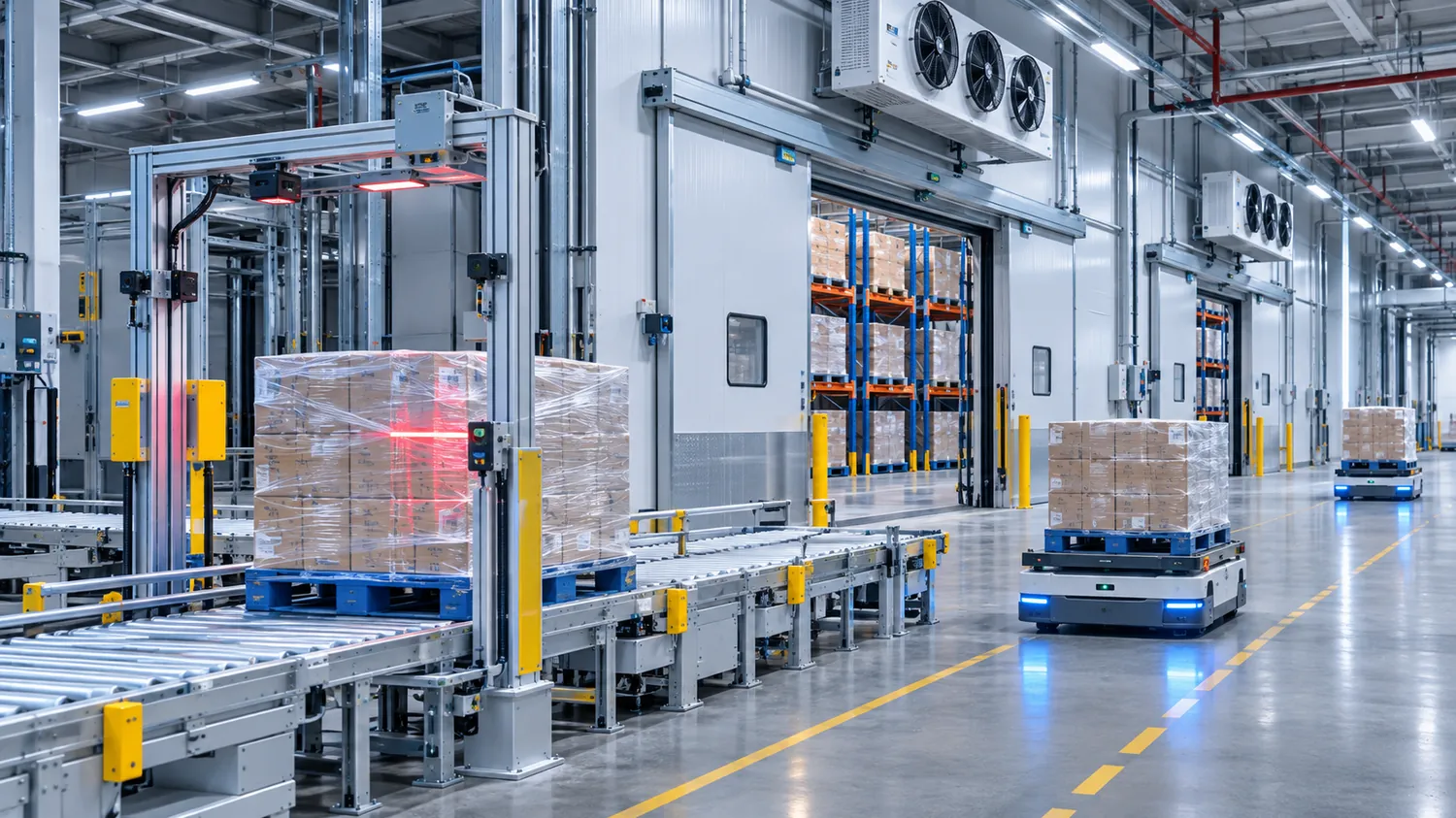
Aerospace manufacturing involves components of widely varying sizes, weights, and structures, from precision-machined parts and composite panels to aircraft engines, wings, and large fuselage structures. These components often need to be moved several times during machining, assembly, and inspection. Some must also have their height, angle, or position adjusted before they can move to the next production step.
Compared with general industrial material handling, aerospace manufacturing often places greater demands on load support, component protection, and positioning accuracy. Manufacturers therefore need to select material handling equipment and automation systems based on the requirements of each production task.
What Is Aerospace Material Handling?
Aerospace material handling refers to the storage, transportation, lifting, turning, and positioning of raw materials, components, and production tooling during the manufacturing, assembly, and inspection of aircraft, spacecraft, and related parts.
The handling method depends on the material’s size, weight, structure, and process requirements. Small precision parts can often be transferred using bins, conveyors, or mobile robots, while large structural components may require dedicated transport platforms, lifting equipment, or positioning devices.
Some handling tasks involve only moving material from one workstation to another. Others also require components to be positioned accurately for subsequent machining or assembly.
Challenges in Aerospace Material Handling
Large and Irregularly Shaped Components
Aircraft wings, fuselage structures, and large production fixtures are often substantial in size. Some also have an offset center of gravity or uneven weight distribution.
Selecting handling equipment for these components requires more than checking total weight. Lifting points, support locations, and load distribution must also be considered. For example, a long wing structure may require multiple support points during handling to avoid excessive localized loads or unnecessary deformation.
These tasks therefore often require dedicated lifting attachments, support frames, or transport fixtures to keep the load stable during movement.
Precision Positioning and Component Protection
Aerospace components often involve tight manufacturing tolerances and high production costs. For composite panels, thin-walled structures, and precision-machined parts, unsuitable gripping or support methods can cause deformation and affect subsequent assembly.
Handling equipment needs contact points, gripping methods, and support fixtures designed for the component’s structure. Impact and vibration during movement must also be controlled.
Once a component reaches an assembly station, its height, angle, and position may need further adjustment. For assembly tasks with demanding accuracy requirements, measurement systems may also be needed to verify its actual position.
Operational Safety and Space Constraints
Aerospace manufacturing facilities often contain large production machines, assembly tooling, and multiple work areas. Large components may occupy wide aisles during transport, while lifting operations must account for surrounding equipment, building structures, and areas where people are working.
For example, moving a fuselage component with an overhead crane requires checking the crane’s coverage and available clearance. Using a heavy-duty AGV requires evaluating floor load capacity, turning space, and obstacles along the transport route.
Appropriate safety measures are also needed where people work close to the equipment, reducing the risk of moving loads colliding with personnel or surrounding machinery.
Types of Aerospace Material Handling Equipment
1. Cranes and Lifting Equipment
Cranes are commonly used to handle large aerospace components, primarily for lifting, moving, and positioning heavy parts.
Overhead cranes are suited to moving large components within a defined area of a facility. Gantry cranes can serve different work areas depending on the site layout. Jib cranes and other specialized lifting equipment may be used at individual assembly stations.
In practice, cranes are often paired with custom lifting attachments. Spreader beams and multi-point lifting devices can distribute loads across long or load-sensitive structures. Some large components also require synchronized lifting controls to prevent excessive height differences between lifting points.
Cranes are well suited to large loads that need vertical lifting, but their operating range is constrained by building structures, crane coverage, and available workspace.
2. Automated Guided Vehicles (AGVs) and Autonomous Mobile Robots (AMRs)
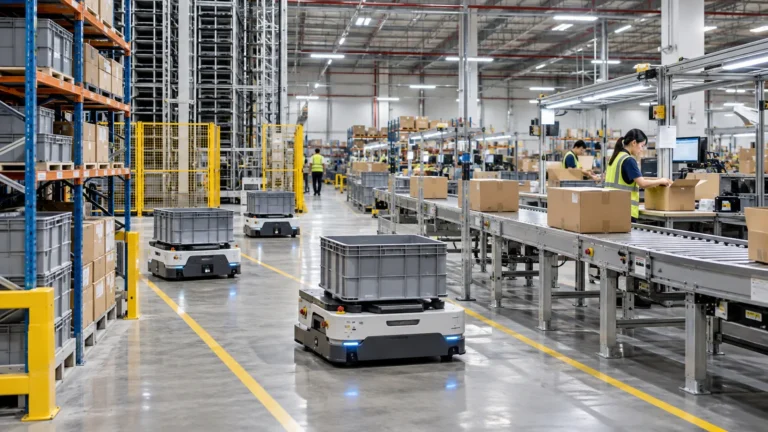
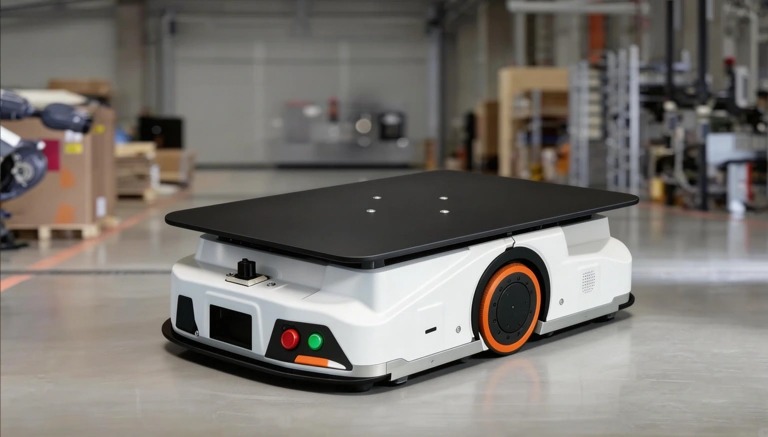
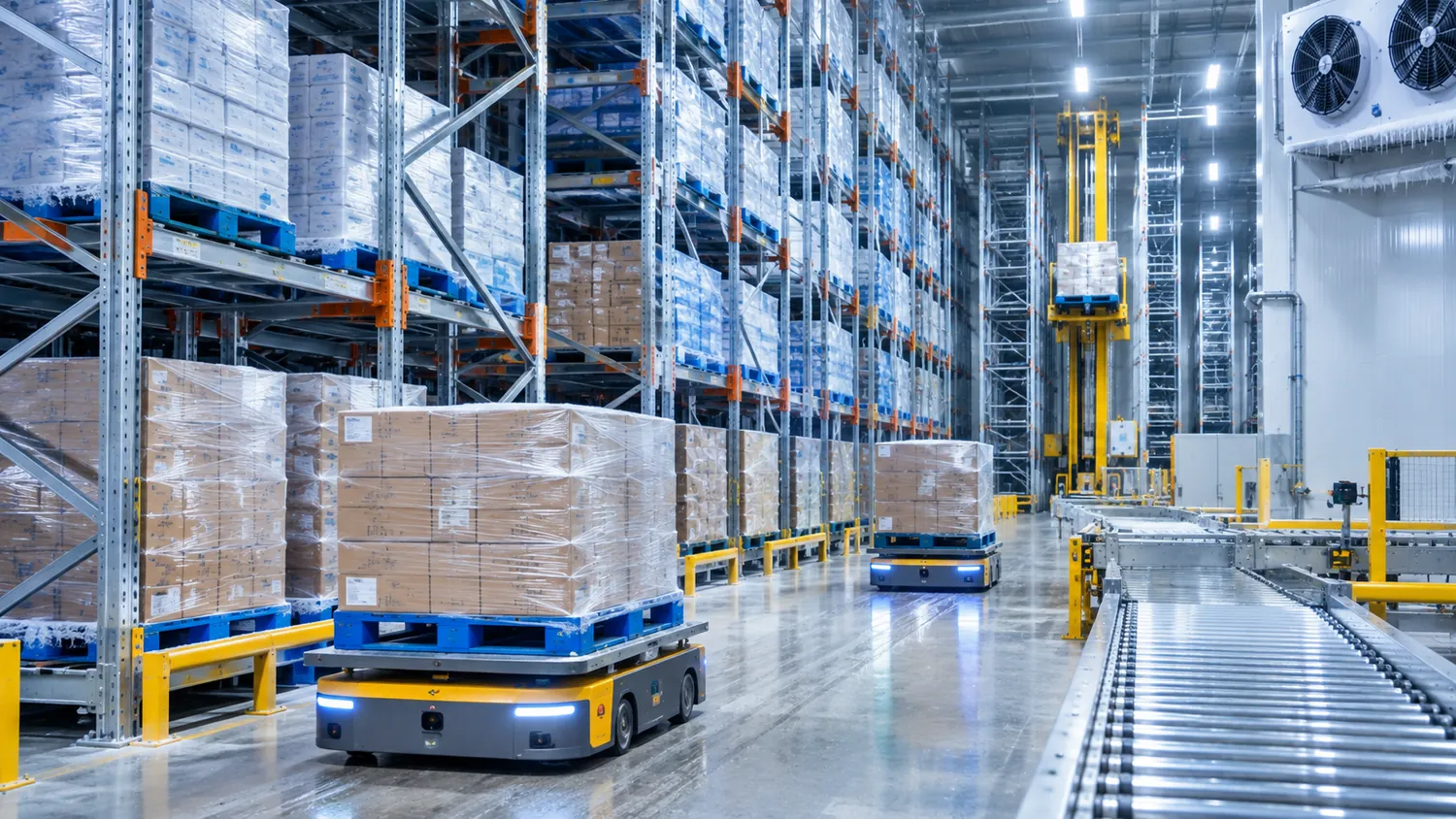
AGVs and AMRs are primarily used for automated material transportation within aerospace factories, particularly for repetitive transfers between workstations and material delivery tasks.
In production environments with relatively fixed routes, an AGV can follow a predefined path. An AMR uses environmental sensing and autonomous navigation to adjust its route where site conditions permit.
For larger or heavier production fixtures and components, heavy-duty AGVs or dedicated mobile platforms may be used. Their design must account for the carrier structure, load distribution, floor load capacity, and stopping-position accuracy.
When designing automated material handling systems, Robotlyne evaluates the appropriate mobile robots and control systems based on material dimensions, transport routes, task frequency, and how loads are transferred at each workstation. For tasks involving multiple production machines, job scheduling, equipment communication, and automatic transfers must also be considered.
AGVs and AMRs primarily handle floor-level transportation. Components that require vertical lifting, complex orientation changes, or high-precision alignment may need to be handled in conjunction with other dedicated equipment.
3. Lifting and Positioning Equipment
Lifting and positioning equipment is used to adjust the height, angle, and orientation of aerospace components so they can be placed in the correct position for machining or assembly.
Common examples include hydraulic lift tables, component turning devices, rotary positioners, and dedicated assembly positioning platforms.
For example, some large structural components need to be reoriented during machining or assembly so operators or automated equipment can access different working surfaces. For engines and other heavy components, lift platforms can adjust the installation height in a controlled manner.
These systems generally need to be designed around the component’s shape, center of gravity, and allowable support points. Operations with demanding positioning accuracy may also use servo drives, position feedback, and measurement systems for fine adjustments.
4. Automated Storage and Conveyor Systems
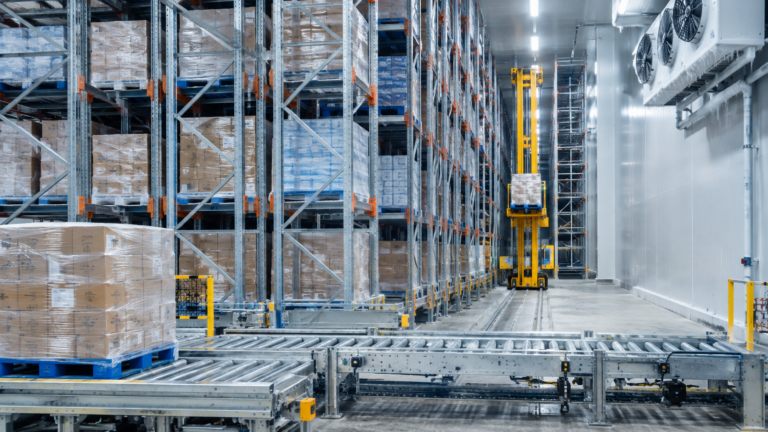
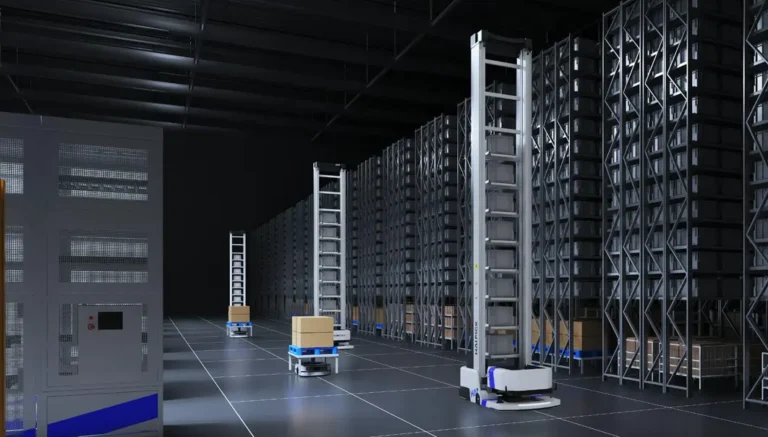
Aerospace manufacturing involves managing a wide variety of components, production fixtures, and materials. Automated storage and retrieval systems (AS/RS) can be used for small and medium-sized items that are stocked in significant quantities and retrieved frequently.
For example, a bin-based AS/RS can store fasteners, small machined parts, and other items suitable for bin storage. Based on retrieval orders, the system automatically retrieves designated bins and sends them to the appropriate location using conveyors or mobile robots.
For larger tooling or palletized components, pallet-based automated storage systems may be suitable, depending on their size, weight, and storage requirements.
Robotlyne’s warehouse automation solutions can integrate AS/RS, AGVs/AMRs, and control software to support material storage and transportation within factories.
Applications of Aerospace Material Handling
Component Machining and Transfers Between Production Stages
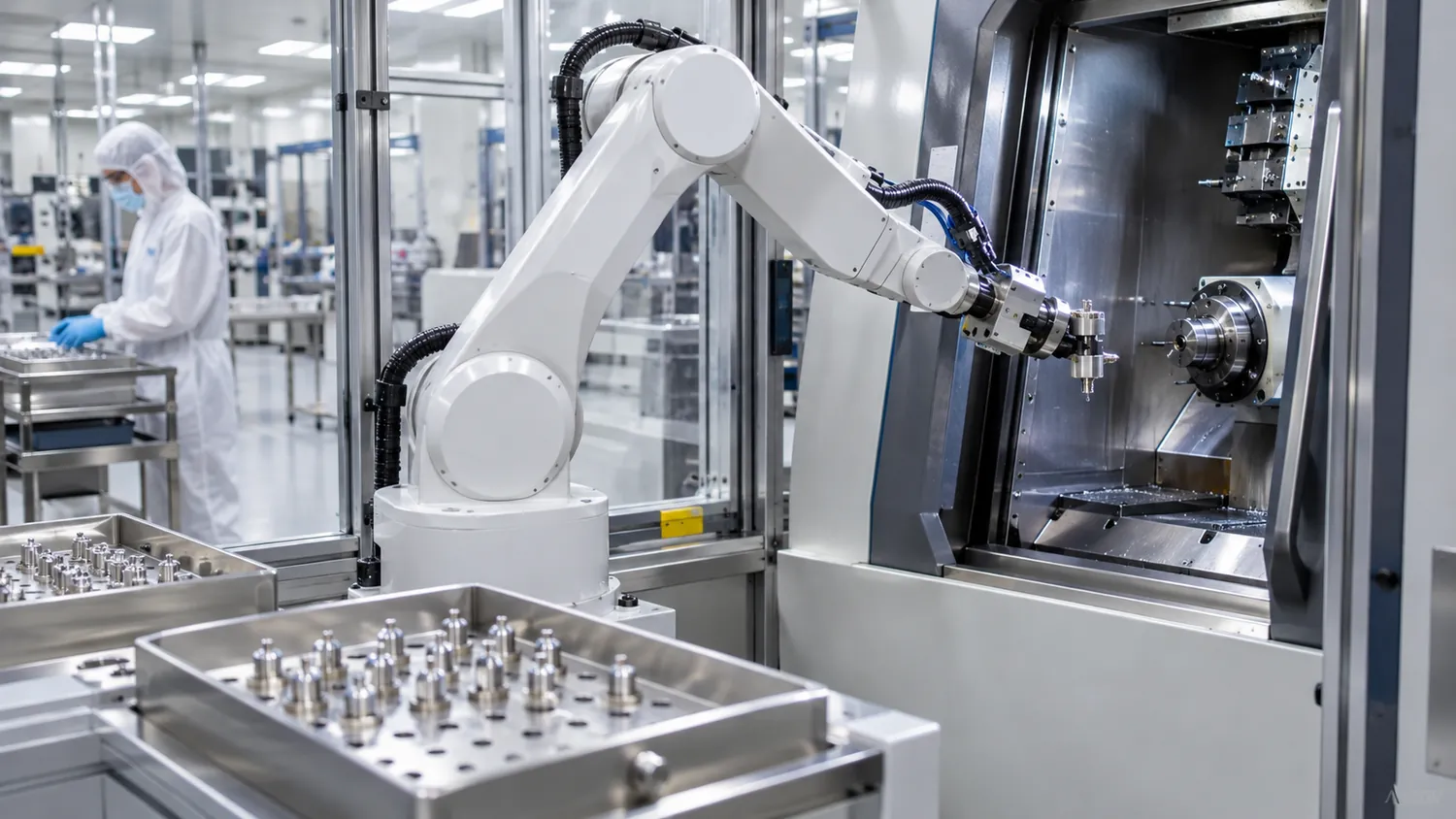
Aerospace components often pass through several machining and inspection stages. Metal structural parts, for example, may undergo CNC machining, deburring, cleaning, and dimensional inspection, with some parts requiring multiple setups or machining operations.
How materials are transferred between stages directly affects production flow. If one operation is finished but a component is not moved promptly, the equipment may sit idle. If the next operation is not ready, parts may accumulate near the workstation instead.
For these tasks, material transportation can be planned around machining cycle times and workstation layout. Dedicated carriers can also maintain the orientation and placement of parts, reducing repeated adjustments during transfers.
Robotlyne’s automated robotic material handling project shows how vision-guided robots can pick and transfer components between a material storage position and multiple processing stations. This approach can also serve as a reference for production lines with similar workstation-transfer requirements.
When several processing machines share one handling system, pickup and delivery sequences must be coordinated so that some machines are not left waiting while excessive work-in-process inventory accumulates elsewhere.
Lifting and Positioning Large Aerospace Components
Handling large aerospace components is often necessary at several stages, including manufacturing, inspection, and assembly. Once a component has been manufactured, it may need to be removed from its original fixture and transferred to an inspection area or the next assembly position.
For example, after a fuselage structural component is manufactured, it may first be placed on a dedicated transport fixture, moved through the factory, and then brought into a final assembly station. At the destination, the load must be transferred to the assembly fixture so that the component is held in the required installation position and orientation.
Beyond meeting the component’s size and weight requirements, the handling plan must account for how loads are transferred between workstations. If transport, lifting, and assembly fixtures use different support locations, the safe transfer of the load needs to be planned in advance.
For large composite structures, unnecessary deformation or localized stress must also be avoided when changing fixtures or transferring components.
Material Handling During Aircraft Assembly
Aircraft assembly requires a wide range of components, tools, and fixtures to be delivered to designated workstations. In addition to large structural parts, fasteners, brackets, tubing assemblies, and other installation materials must be supplied according to production requirements.
These items have different usage frequencies and delivery needs. Common fasteners, for example, may need regular replenishment, while specialized parts may be delivered for specific assembly tasks.
In assembly facilities with a large number of material types, parts can be prepared in advance based on the production schedule and delivered in kits organized by workstation or task. This reduces the time operators spend searching for and collecting materials.
Delivery timing must also be coordinated with assembly progress. Delivering materials too early can occupy limited workstation space, while late deliveries can delay assembly operations.
Material handling during aircraft assembly therefore involves more than equipment carrying capacity. It also requires effective material preparation, workstation delivery, and handoff processes.
If you are planning to automate material handling in aerospace manufacturing, Robotlyne can help assess AGV/AMR, automated storage, and related equipment integration options based on your material specifications, transport routes, and production workstation requirements. Contact us to discuss your project.