Project Objectives
A modular production-line concept integrating robotic dispensing, multi-directional screwdriving, product flipping, labeling, electrical testing, buffer storage, and production-data visibility for EV charger power modules.
The project was planned to connect multiple downstream assembly and test processes after the front-end preparation of two mainboards. The line needed to handle products with different board and module dimensions while maintaining orderly pallet circulation, accessible rework points, and coordinated transfer into a downstream buffer store.
- Automate dispensing, screwdriving, flipping, labeling, and electrical testing.
- Use a compact U-shaped layout with double-deck pallet return conveyors.
- Combine online robotic stations with selected offline processes where required by takt or handling constraints.
- Provide buffer storage and production-data interfaces for downstream coordination and traceability.
Our Solution
Compact U-Shaped Pallet Conveyor Line
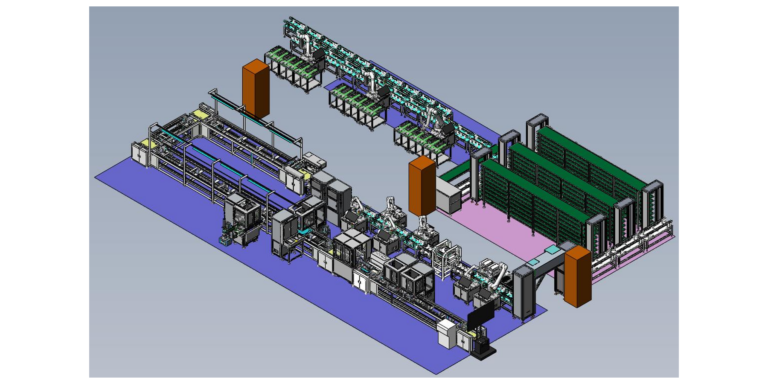
A double-deck pallet conveyor circulates fixtures through the manual and automated sections. A 90-degree pallet turntable connects the U-shaped sections, while processing and rework positions are arranged after equipment stations to support controlled exception handling.
Robotic Dispensing and Multi-Side Screwdriving
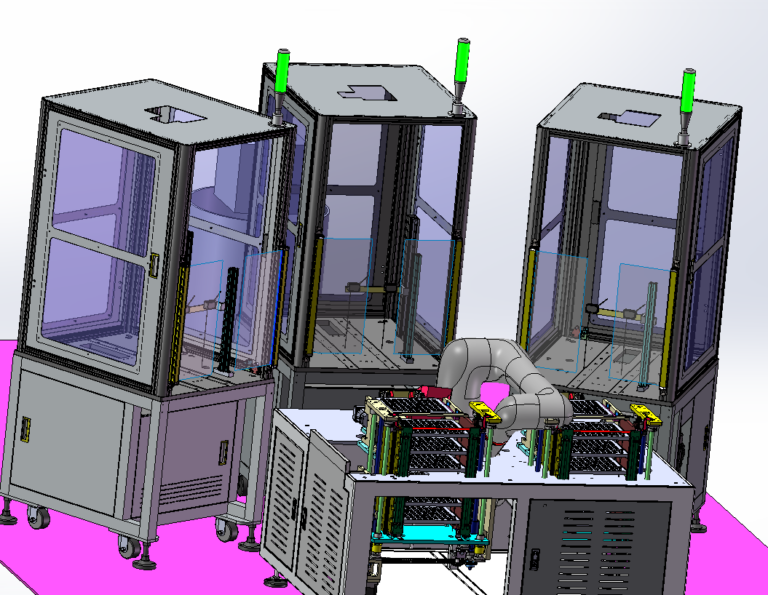
Vision-guided dispensing stations use robotic motion, pneumatic dispensing valves, and pressure-plate pumps. Screwdriving stations combine collaborative robots, CCD positioning, smart electric drivers, laser-distance sensing, and automatic screw feeding to cover both top and side fastening positions.
Automated Flipping, Labeling and Electrical Testing
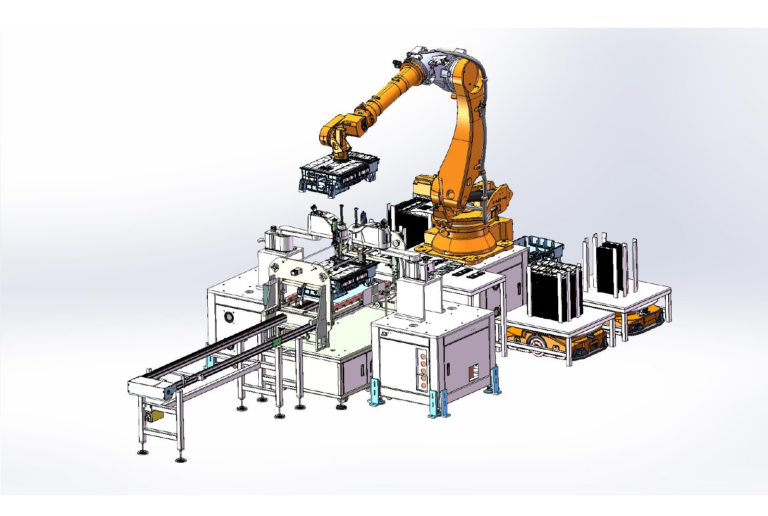
Dedicated mechanisms rotate the mainboard or complete module by 180 degrees. A dual-head labeling station uses CCD positioning for large and small labels, while robot handling transfers products among insulation-withstand and functional test stations.
Three-Level Buffer Storage and Digital Visibility
A lift and multi-level belt arrangement buffers finished modules before discharge. A digital dashboard and MES-ready software interface support production monitoring, station-status display, yield reporting, and product pass-through records.
Process Flow
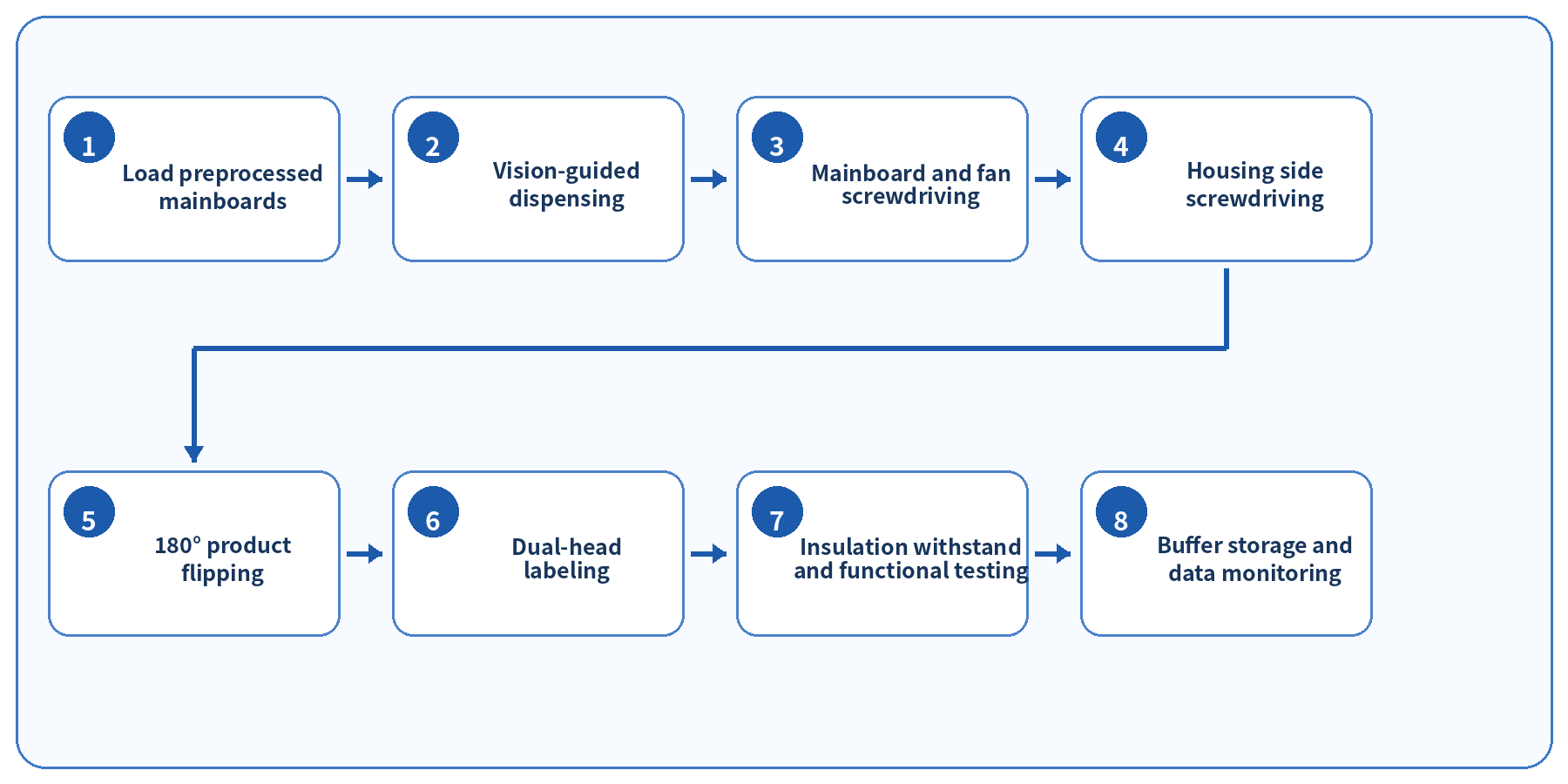
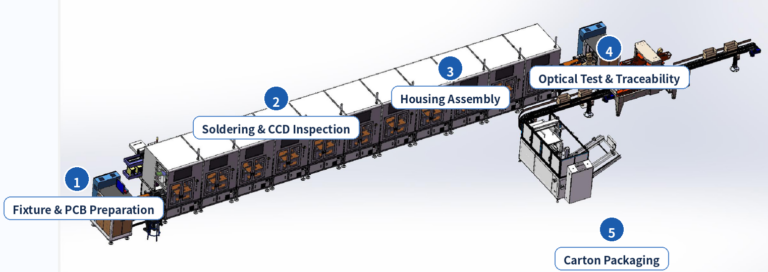
Preprocessed mainboards enter the pallet line, after which dispensing and fastening operations are completed through a combination of online and offline stations. The assembled module is flipped, labeled, electrically tested, and then transferred to the buffer store. Production and station data can be presented through the line dashboard and software system.
System Layout
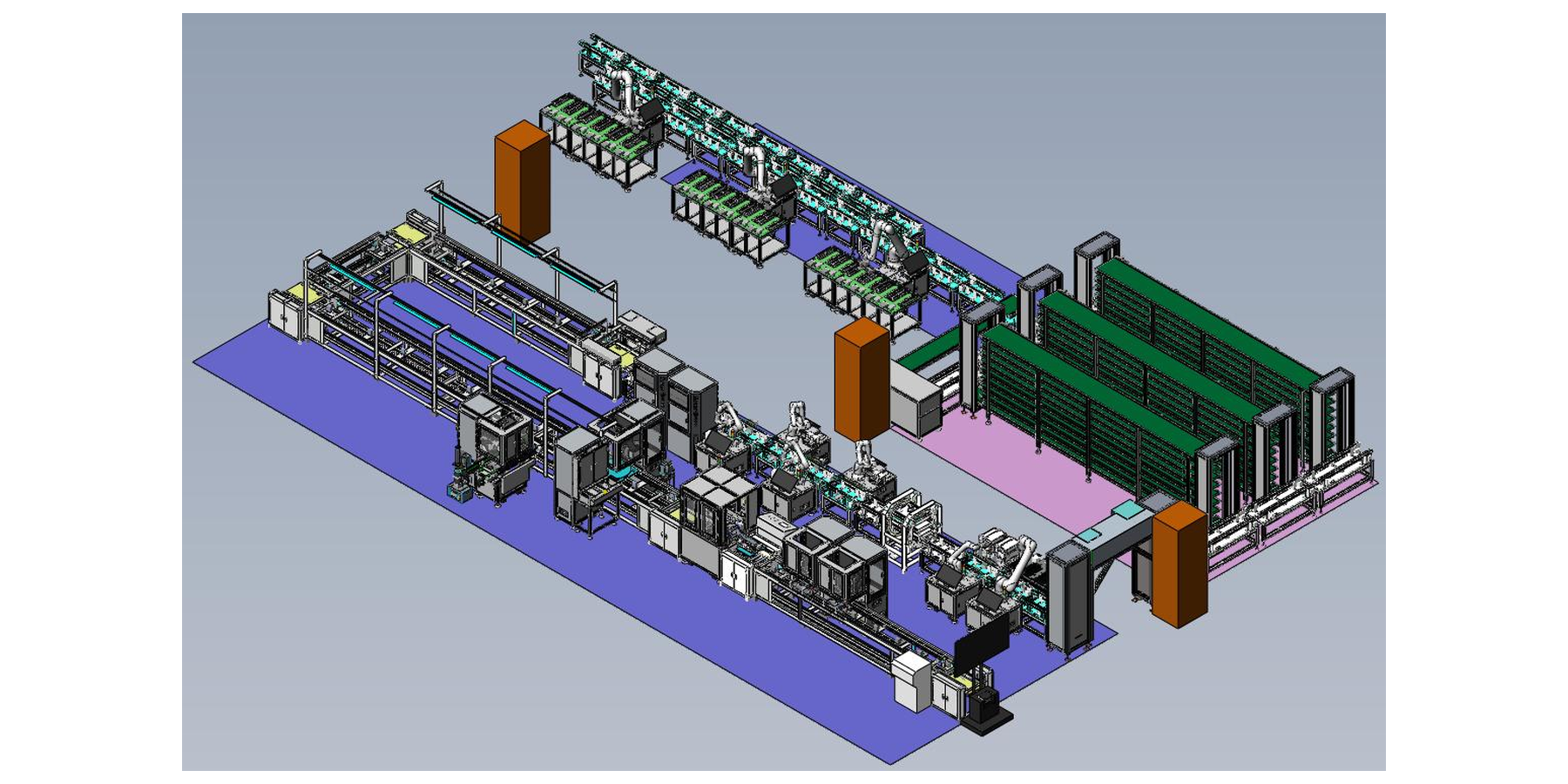
| Zone | Functional Area | Main Operations |
| 1 | Manual Preparation and Pallet Circulation | Manual loading, double-deck pallet return, U-shaped line transfer, and rework handling. |
| 2 | Dispensing and Mainboard Assembly | Online and offline dispensing, Mainboard 1 and Mainboard 2 fastening, and fan-module preparation. |
| 3 | Module Assembly and Flipping | Housing side screwdriving and 180-degree flipping of the mainboard or complete power module. |
| 4 | Labeling and Electrical Testing | CCD-guided dual-head labeling, insulation-withstand testing, and functional and debugging tests. |
| 5 | Buffer Storage and Data System | Bridge transfer, multi-level buffer storage, production dashboards, and MES-ready data interfaces. |
Key Equipment Solutions
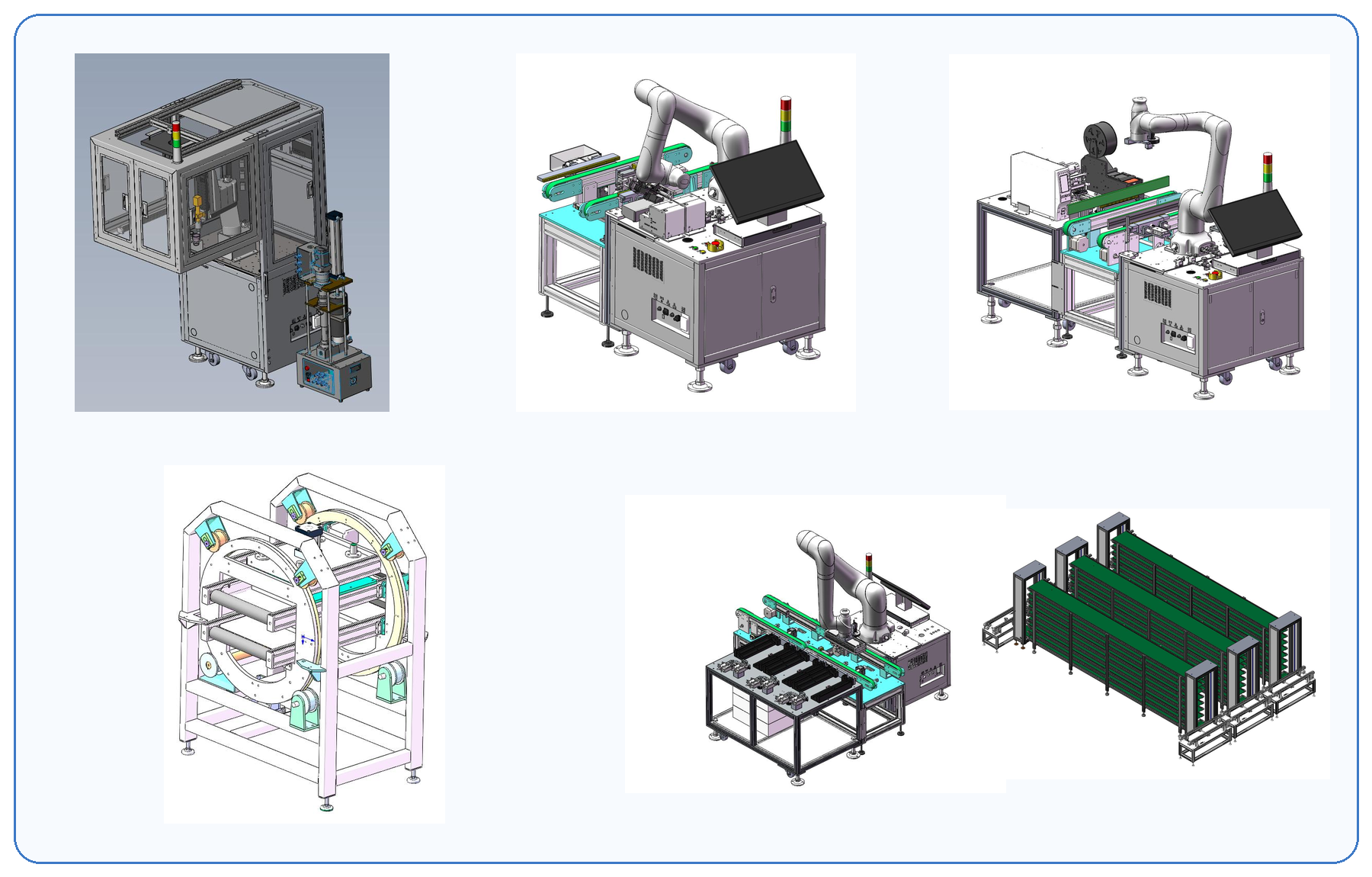
| No. | Equipment Solution | Role in the Production Line |
| 1 | Double-Deck Pallet Conveyor System | Transports products through the assembly and testing processes while returning empty pallets through the lower conveyor level. |
| 2 | U-Shaped Pallet Transfer Unit | Rotates the upper and lower transfer platforms by 90 degrees to connect the conveyor sections in the U-shaped production layout. |
| 3 | Vision-Guided Robotic Dispensing Station | Uses a robot, CCD vision, pneumatic dispensing valve, and pressure-plate pump to follow the programmed dispensing path across the mainboard. |
| 4 | Automatic Screwdriving System | Integrates a robot, intelligent screwdriver, CCD vision, laser distance sensor, screw feeder, screw sensor, and fastening cylinder for controlled screw installation. |
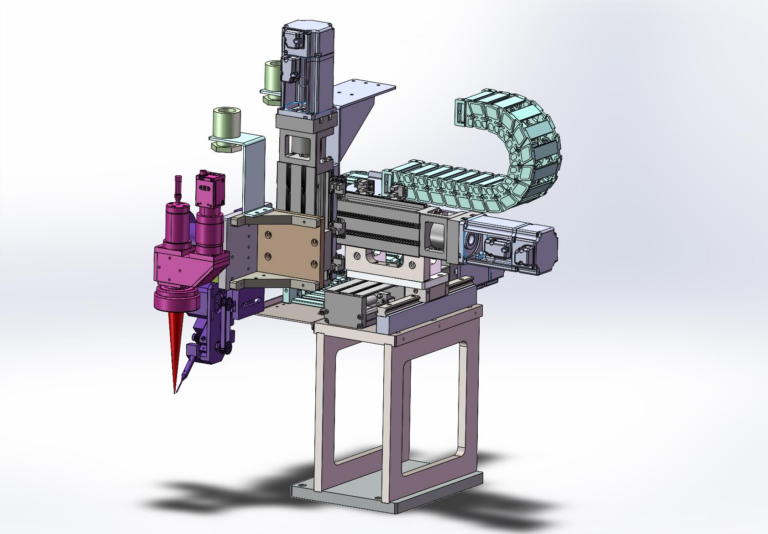
| 5 | Six-Axis Side Screwdriving Station | Moves a CCD-equipped screwdriving attachment around the power module to fasten screws on different sides and orientations. |
| 6 | Offline Fan Module Screwdriving Station | Moves manually loaded fan modules along a Y-axis into the fastening position before returning them to the unloading area. |
| 7 | 180-Degree Product Flipping System | Clamps or vacuum-grips the mainboard or complete module and rotates it by 180 degrees for access to the next assembly surface. |
| 8 | CCD-Guided Dual-Head Labeling Station | Locates the product reference point and label position before applying large and small labels with a collaborative robot. |
| 9 | Insulation-Withstand Test Handling Station | Scans the product barcode, locates the reference point, and uses a six-axis collaborative robot to transfer the module between three electrical test positions. |
| 10 | Multi-Level Buffer Storage System | Uses infeed conveyors, vertical lifts, storage belts, and discharge positions to buffer products between assembly and downstream testing operations. |
| 11 | Production Dashboard and MES Interface | Displays production status, equipment operation, yield, and station records while supporting local data storage and MES-ready data exchange. |
Specification
| Specification | Value | Notes |
| Application | EV Charger Power Module Production | Automated dispensing, screwdriving, flipping, labeling, electrical testing, buffer storage, and production-data management. |
| Mainboard Length Range | 340–400 mm | Supported length range for Mainboard 1 and Mainboard 2. |
| Mainboard Width Range | 207.5–307 mm | Reference width range specified for the mainboards entering the line. |
| Power Module Length Range | 437.5–460 mm | Supported length range for the assembled charging-power modules. |
| Power Module Width Range | 218–300 mm | Reference width range specified for the complete modules. |
| Conveyor Configuration | Double-Deck Pallet Conveyor | The upper level transports products while the lower level returns empty pallets through the U-shaped production layout. |
| Main Line Reference Footprint | 19,000 × 6,200 mm | Reference dimensions shown for the primary automated conveyor and equipment section. |
| Buffer Storage Dimensions | 7,950 × 5,367 × 2,280 mm | Reference overall dimensions of the proposed multi-level buffer storage system, L × W × H. |
| Estimated 40-Series Buffer Capacity | Approximately 459 units | Preliminary capacity estimate based on the proposed storage arrangement. |
| Estimated 30-Series Buffer Capacity | Approximately 540 units | Preliminary capacity estimate; the final storage design requires further engineering confirmation. |
| Insulation-Withstand Test Positions | 3 Stations | A six-axis collaborative robot transfers products among three electrical test positions. |
| Robot Configuration | Six-Axis Collaborative Robots | Used for dispensing, multi-side screwdriving, labeling, product transfer, and electrical-test handling. |
| Production Data System | Dashboard + MES Interface | Supports production-status visualization, equipment monitoring, yield reporting, local data storage, and MES-ready data exchange. |
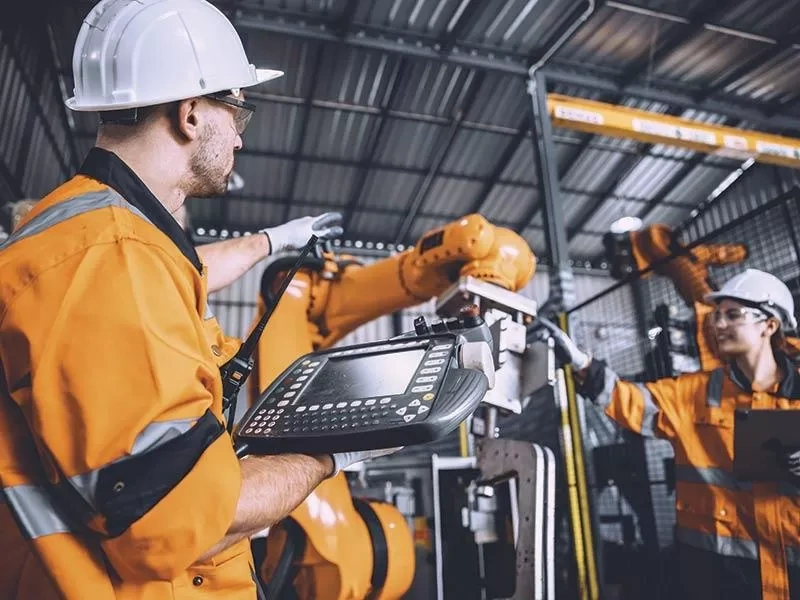
Request a Technical Consultation and Project Evaluation
Robotlyne can evaluate your product variants, takt requirements, process sequence, testing strategy, buffer capacity, and data-integration needs to develop a tailored automation concept.